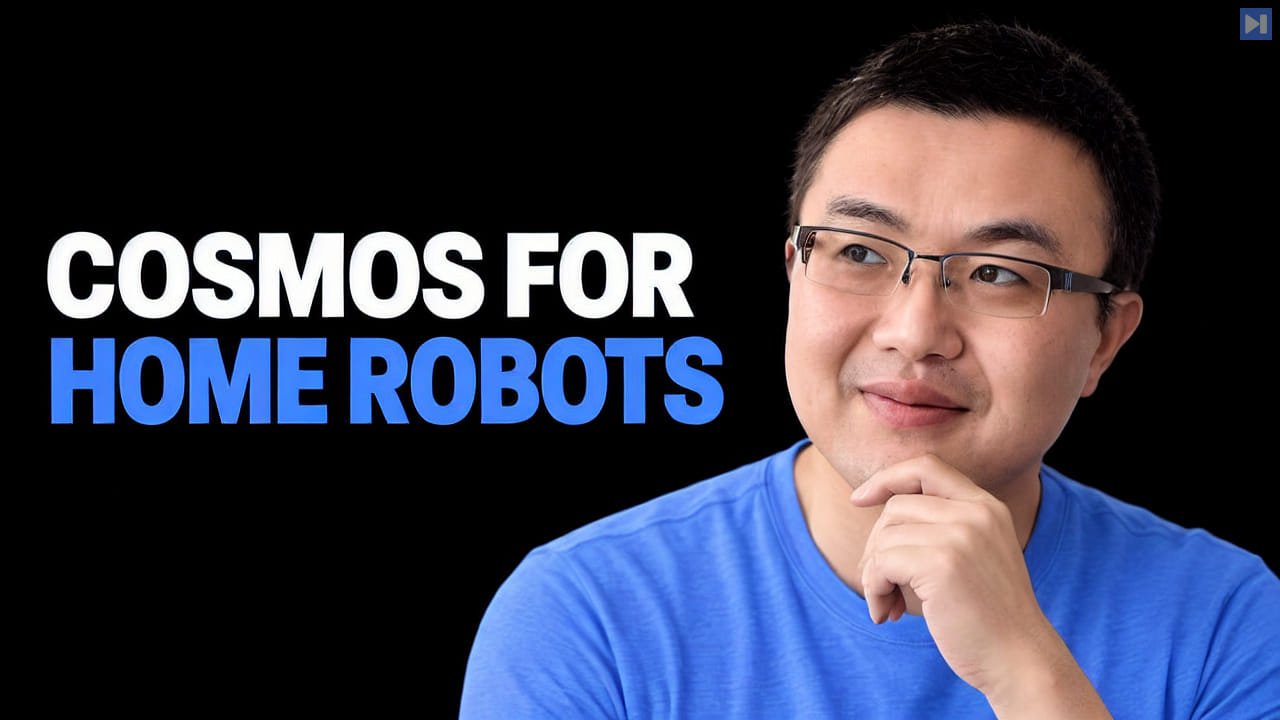
Nate B Jones interviews Ming-Yu Liu, vice president of NVIDIA's Cosmos Lab, about world modelsA world model learns how an environment is structured and how it may change in response to actions. for robots and autonomous systems. Liu describes world understanding, simulationRobot simulation is a virtual test environment where developers can observe and improve robot behavior before trying it with physical hardware. and action as related capabilities: a model may interpret a scene, generate a plausible environment for testing, or help produce physical control actionsPhysical AI uses learned perception, reasoning and control to act through machines in the physical world.. That is more specific than saying every world model simply issues robot commands.
The conversation covers model sizes for edge devices and data centers, scaling through more data and richer descriptions, and using physics engines to create synthetic training scenarios. Liu stresses that a generated scene approximating physical behavior is not proof the model understands physics. Cosmos can help screen driving or robot policiesA robot policy is the decision-making function that maps observations and goals to actions a robot should take in its environment. in simulation, but real-world validation remains important, especially for rare events and changing environments.
For home robots, Liu expects tasks with observable outcomes, such as folding laundry, to become verifiable sooner than taste-dependent cooking. Both speakers frame general household competence as an open challenge. They also discuss specialized agent tools and NVIDIA's preference for open models; future capabilities described near the end are expectations, not demonstrated household products.
 Watch on YouTube