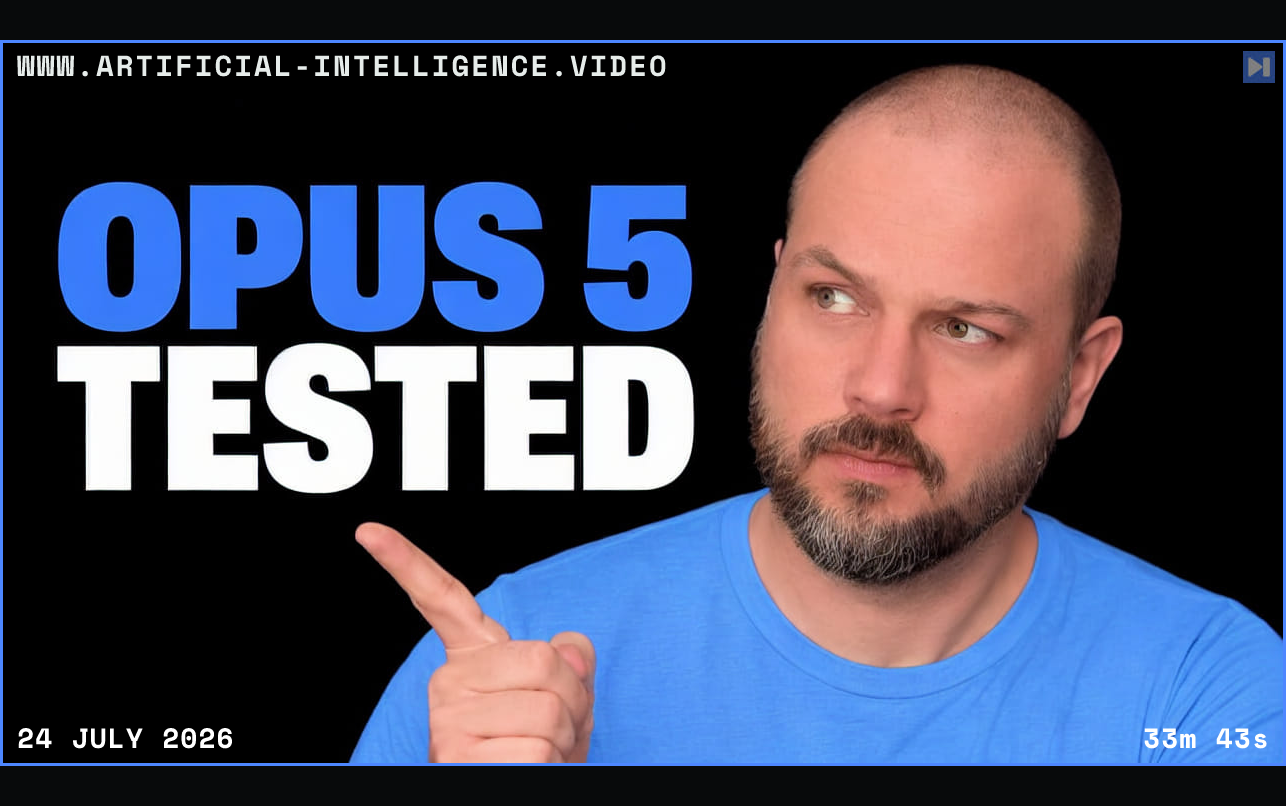
Wes Roth explains reported Opus 5 gains on ARC-AGI tasks, focusing on sample efficiencySample efficiency measures how much useful learning an AI system achieves from a given number of training examples or experiences. and adapting to unfamiliar environmentsGeneralization is an AI system's ability to apply what it learned to new examples and conditions that were not part of its training experience.. He describes how text-based puzzle representations can support algebraic reasoning, while presenting benchmarkA benchmark is a defined test or collection of tasks used to compare a system's performance under specified conditions. interpretations as the evidence discussed in the episode.
Wes Roth examines system-card reports about moral patienthood, consultation and control. He separates model self-reports from proof of consciousnessMachine consciousness is the possibility that an artificial system could have subjective experience, rather than merely produce behavior associated with it., notes that those reports may reflect training, and connects the discussion to instrumental convergence as an interpretation rather than an established diagnosis of model motives.
Wes Roth demonstrates a descent-style 3D game produced through one user promptCode generation uses AI or another automated system to create source code from instructions, examples, schemas, or higher-level specifications. and several model iterations. He praises its controls and atmosphere but identifies unclear enemy visibility and wall-crossing behavior, preserving the difference between a promising starting point and a finished production game.
 Watch on YouTube