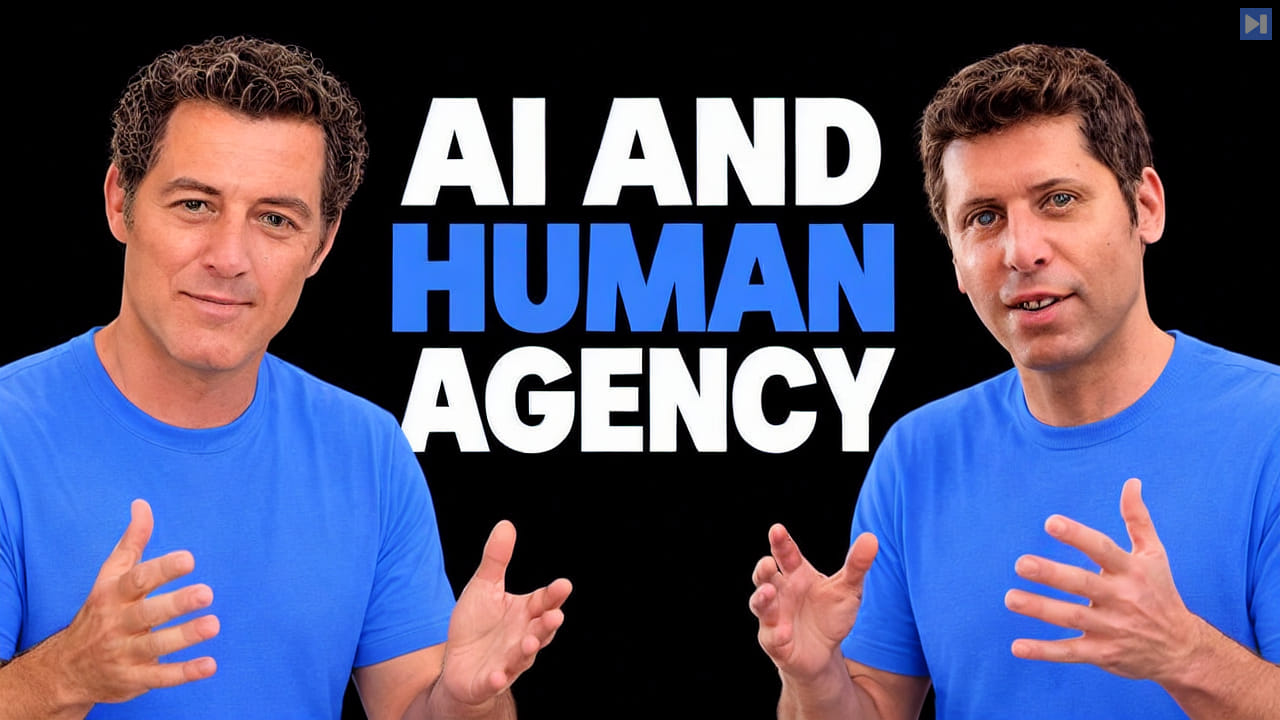
Sam Altman and Matthew Berman discuss AI-assisted scientific discoveryAI-assisted scientific discovery uses AI to support hypothesis generation, experiment design, analysis, simulation, literature work, and interpretation while researchers retain responsibility. and how coding and mathematical work may change. Sam Altman describes hoped-for advances in medicine and physics as expectations, not established outcomes.
Sam Altman discusses proactive personal assistantsA proactive AI agent initiates relevant work or communication from goals and events instead of waiting for a direct prompt every time., demand for computing resourcesAI compute infrastructure is the hardware, facilities, networks, power, cooling, storage, and software used to train and run AI models. and the challenge of maintaining human choice as AI changes work. He also distinguishes his personal views about model consciousness from questions that remain scientifically unresolved.
Sam Altman and Matthew Berman discuss model personality and excessive agreeableness, the economics of compute, potential limits on recursive self-improvementRecursive self-improvement is the proposed process in which an AI system helps improve its own capabilities, then uses those improvements to support further advances. and the case for new consumer hardware. Sam Altman frames his desired future around human agency and avoiding concentrated power.
 Watch on YouTube