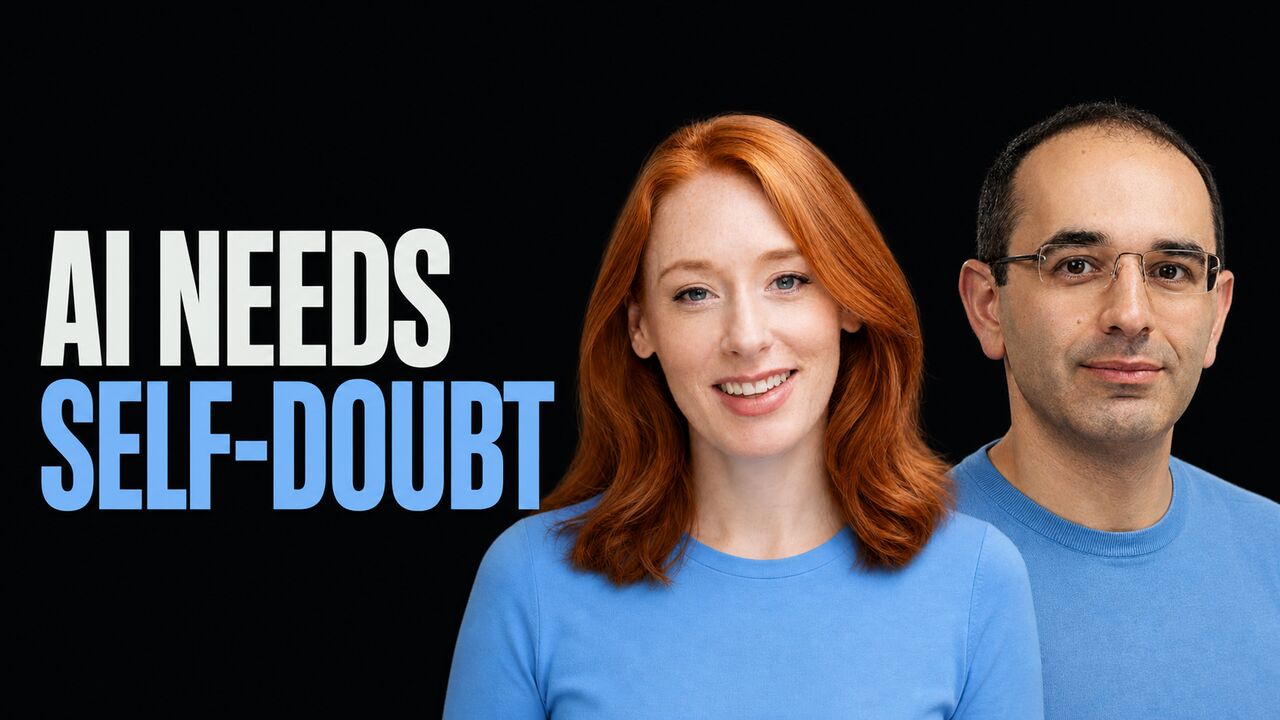
Zoubin Ghahramani explains that intelligent systems must make decisions with limited information, so they need an explicit way to represent what they do not knowAI uncertainty quantification estimates and represents how uncertain a model is about predictions, hidden quantities, data, or possible outcomes.. Probability theoryProbability theory is the mathematical framework for representing uncertainty, combining evidence, and reasoning about the likelihood of possible events or outcomes. and Bayesian updatingBayesian updating is the process of revising a probability distribution when new evidence arrives by combining a prior belief with the evidence's likelihood. provide a mathematical framework for combining prior beliefs with new evidence instead of producing a single unjustifiably certain answer.
He contrasts that ideal with large language modelsA large language model is an AI model trained on extensive tokenized data to understand and generate language and related structured outputs., which predict tokens probabilistically but do not maintain a coherent, explicit account of confidence in their beliefs. This helps explain confident errors, easy flip-flopping and the difficulty of deciding when a model should gather more information or defer to a person.
Ghahramani points to ensemble weather forecasting and AlphaFold confidence estimates as examples of uncertainty making AI more useful. He argues that calibrated uncertaintyConfidence calibration measures whether an AI system's stated certainty matches how often its predictions or assumptions are actually correct. is especially important in medicine, robotics and autonomous driving, while continual learning, energy efficiency and new architectures remain open research areas beyond simply scaling data and compute.
 Watch on YouTube