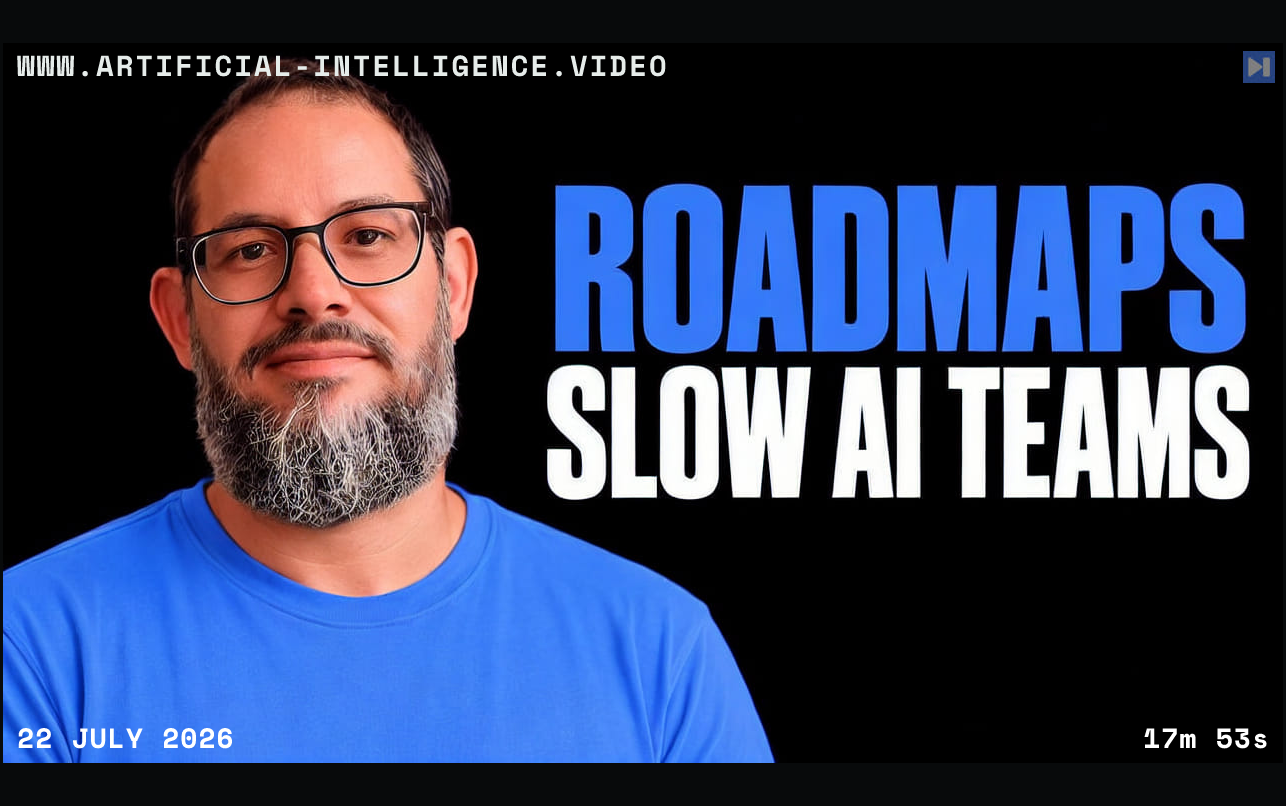
Nate B Jones argues that fast AI companies do not win simply because they have better models. Their advantage comes from organizational habits that make decisions legible, reusable and executable instead of leaving them trapped in meetings, tickets and individual memory.
He lays out rules for moving repeatable human interactions toward codeWorkflow automation uses software or AI to complete a connected sequence of routine steps with less manual effort., documenting choices so agents can act on themContext engineering designs how relevant instructions, evidence, state and tool information are assembled for a model's task. and letting product managers work closer to the terminal. Shorter loops expose errors sooner and make it cheaper to change direction as new evidence appears.
Fixed roadmaps become dangerous when they preserve old assumptions while model capability and customer expectations change quickly. Jones recommends clear goals and constraints, but treats detailed long-range task sequences as hypotheses that should be revised through continuous delivery and feedbackAn AI feedback loop occurs when AI outputs or their consequences become inputs that influence later model or agent behavior..
 Watch on YouTube