Hallucinations can include fabricated facts, citations, events, code behavior, or confident claims that are not supported by the available evidence. They can arise from prediction uncertainty, weak grounding, misleading context, data problems, or pressure to provide an answer.
Detection and reduction can combine retrieval, source verification, calibrated uncertainty, constrained tools, interpretability research, adversarial testing, and human review. No single internal feature is guaranteed to explain every hallucination mechanism.
ELI5
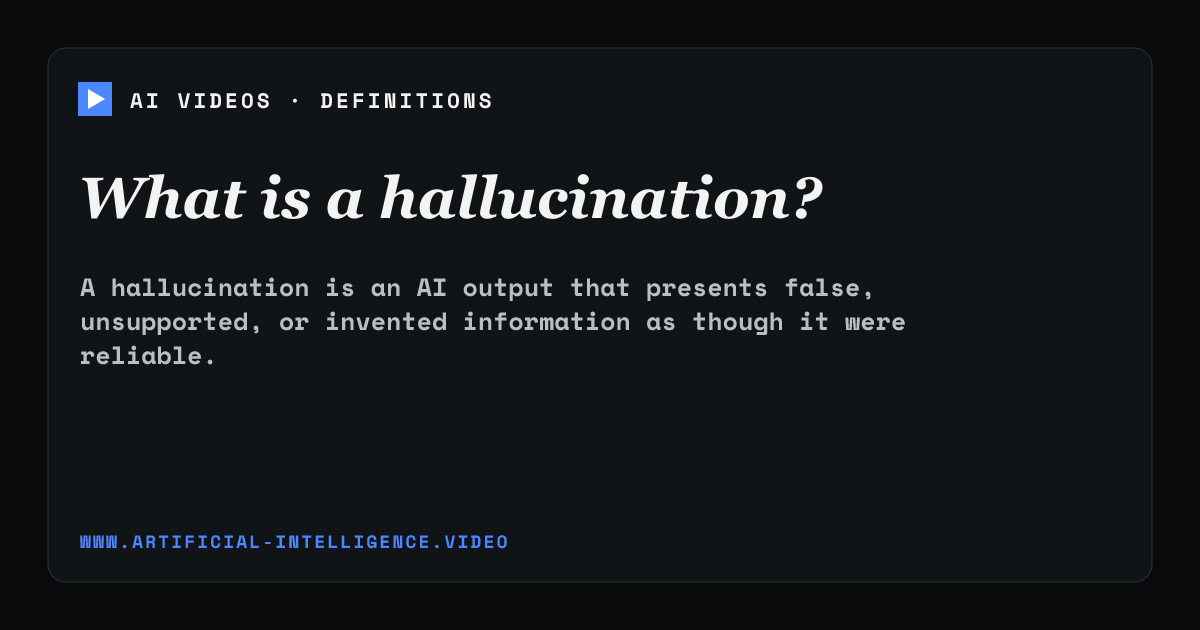
A hallucination happens when an AI produces a claim that sounds plausible but is not supported by the facts or source material. The model is generating likely language, so a confident tone does not prove that the information is true.
For example, an AI might invent a book title and author when asked for a source it does not know. Supplying reliable evidence, checking citations, limiting the allowed answer format, and having a person review important outputs can reduce the risk, but they do not guarantee that every answer is correct.
Why do AI models hallucinate?
Causes can include uncertain prediction, missing knowledge, weak grounding, misleading context, noisy data, prompt pressure, and a lack of reliable verification.
How can hallucinations be reduced?
Use trusted retrieval, citations, verification tools, calibrated uncertainty, constrained outputs, targeted evaluation, interpretability research, and human review for important claims.