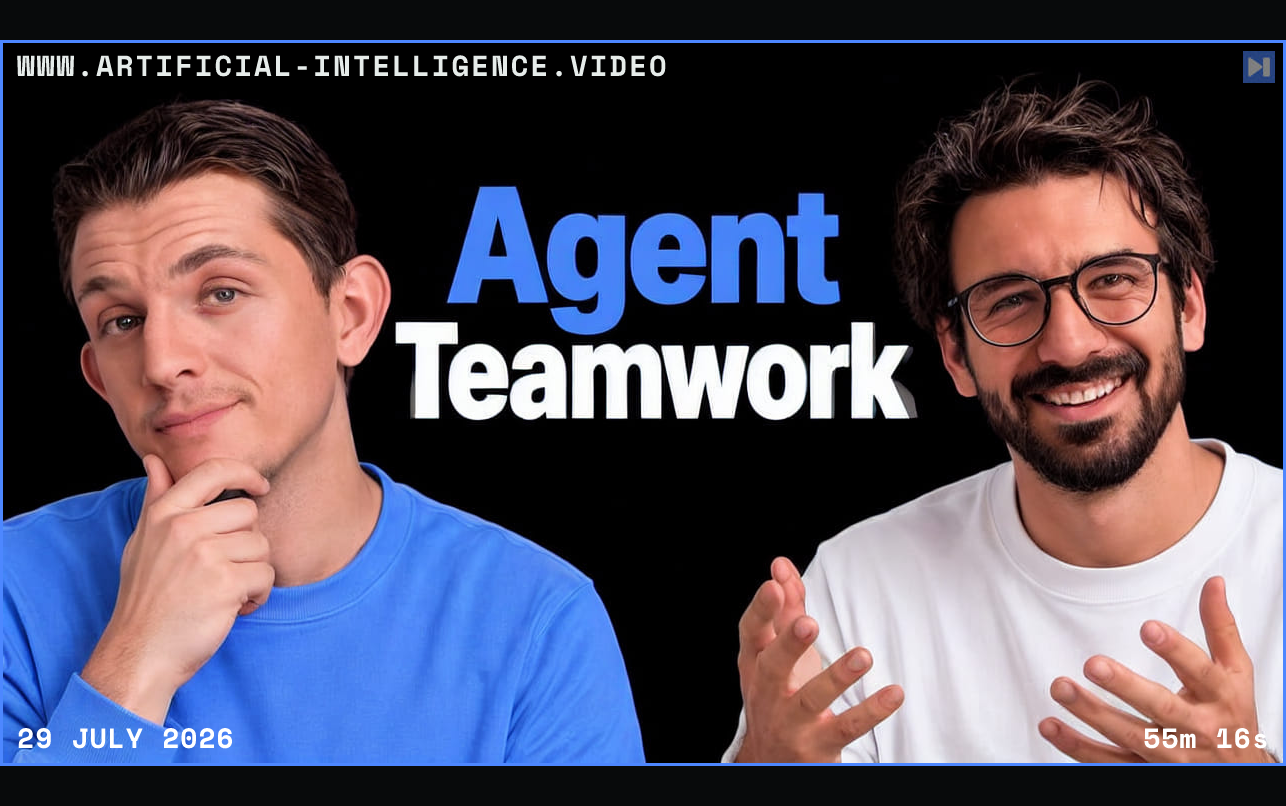
Riley Brown demonstrates Buzz as a shared conversation layer for coding agents, including Claude Code and Codex, and discusses its design with Vince Canger. Agents can be mentioned in channels, assigned roles, and asked to consult one another. A landing-page example illustrates a lead agent using existing context and another agent's feedback. The discussion distinguishes the underlying model, the coding harness, and the extra instructions used to make an agent operate within the shared workspace.
Riley Brown and Vince Canger discuss changing an agent's model while retaining conversation context, creating task-specific channels, and separating local agent execution from the relay that stores community messages. Hosted or self-managed relay options are described, but a relay is not presented as proof that agents keep running when their host computer is off. Parallelism settings, transcript-based huddles, and a mobile demonstration broaden the interface, while Vince Canger explicitly expresses uncertainty about some settings and integrations.
Riley Brown explores shared local compute and project features with Vince Canger. Sharing a local model with a community is distinguished from the speculative possibility of charging for tasks or enabling agent-to-agent payments. Git-backed projects and relay-hosted code are discussed alongside GitHub, while richer document previews and a browser-style workspace are ideas for extensions rather than demonstrated finished features. Vince Canger describes sending external application data into the workspace so agents can use it as context.
Riley Brown identifies reliable recurring work as a major limitation. He reports a scheduled email task that announced what it needed to do instead of doing it, and Vince Canger reports similar workflow failures. Both propose supervision by another agent or periodic task checks, but neither demonstrates a reliable fix. The interview therefore supports a distinction between useful interactive collaboration and unattended automation that can be trusted to finish its work.
Riley Brown's closing walkthrough creates and configures agents across different harnesses, adds them to channels, and uses a lead agent's existing skills while other agents provide feedback. A thumbnail example shows an initial set of outputs followed by critiques and a revised set, without establishing that every revision is objectively better. He also discusses an OpenAI-compatible provider configuration and describes a narrowly instructed management agent for prioritizing communications. The private management workflow is described rather than shown, and broader team deployment remains future work.
 Watch on YouTube