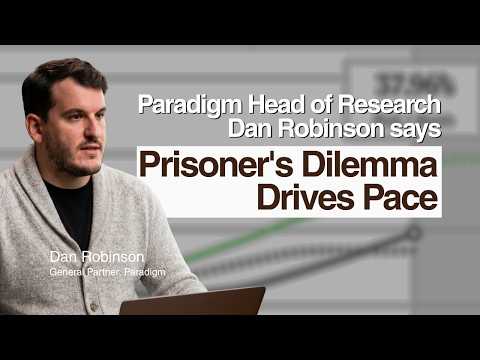
Dan Robinson joins Theo Jaffee and Sofia Puccini to demonstrate a game about competition between AI labs. Players balance cash flow and technical progress against a moving safety frontier. Dan Robinson explains how individually rational choices can create a prisoner's dilemmaA prisoner's dilemma is a strategic situation where individually attractive choices can produce a worse shared outcome than cooperation.: both players may prefer a slower collective pace while fearing the consequences of falling behind.
Dan Robinson distinguishes circumstances that favor racing, voluntary restraint or multiple possible equilibria. The demonstration explores uncertain safety progress, delayed information and the limits of coordination without reliable communication. Dan Robinson argues that greater transparency can help competitors avoid harmful racesGovernance sets responsibilities, rules and oversight for decisions about how AI systems are used., while emphasizing that the game simplifies real institutions and strategic choices.
Dan Robinson also discusses recursive self-improvementRecursive self-improvement is the proposed process in which an AI system helps improve its own capabilities, then uses those improvements to support further advances. and the bottlenecks that remain when research labor is automated. Compute, data and other scarce inputsAI compute infrastructure is the hardware, facilities, networks, power, cooling, storage, and software used to train and run AI models. can limit acceleration, while tasks that resist automation may become increasingly important. These are lessons from simplified economic models and exploratory games, not precise forecasts of what AI labs will do.
 Watch on YouTube