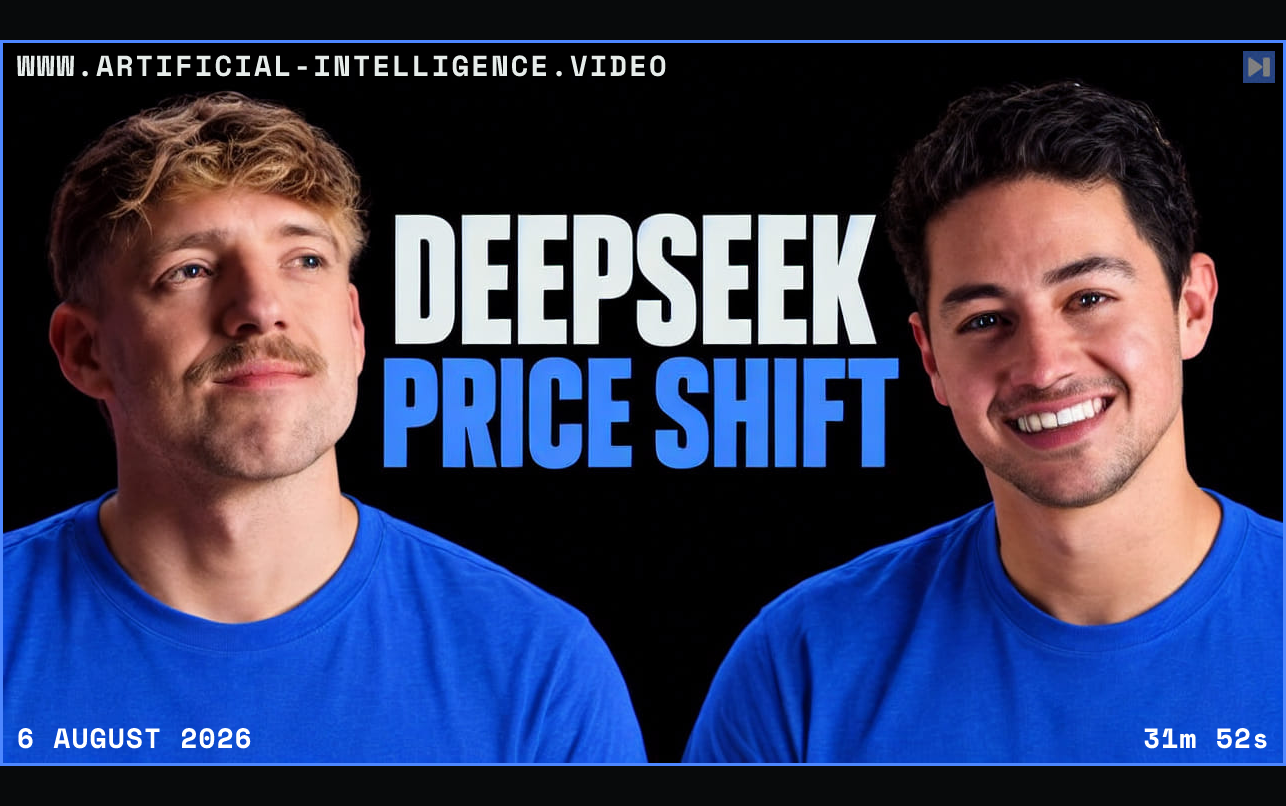
Nick Saraev and Jack Roberts open with DeepSeek's warning that its API pricingToken pricing is the rate an AI provider charges for processing input tokens, generating output tokens, or reading cached tokens. will increase. They note that the amount had not yet been announced at the time of recording, and debate whether users who adopted it for low-cost agent workloads would switch providers. Their claims about competitors' relative prices and DeepSeek's commercial motives are episode-time commentary, not current pricing guidance or verified company intent.
The discussion turns to a reported Google leadership change, then to a Meta coding-agent offer in which a cheaper tier permits training on submitted code. The hosts frame that as a tradeoff between cost and control of source-code data. They also discuss a third-party agent harnessAn AI agent harness is the software framework that packages a model with tools, instructions, context management, execution controls, and user interaction. and reported benchmark gains, emphasizing that task performance depends on the surrounding tool setup as well as the underlying model. The cited demonstrations do not establish broad human-level performance.
The final audience questions range from browser-agent security to sales models. For listeners choosing an AI providerModel selection chooses the AI model whose capability, quality, cost, speed, safety, and operating constraints best fit a task., the durable lesson is to compare current per-task costCost per completed task measures the total AI, tool, infrastructure, retry, and repair expense for each verified useful outcome., data-use terms and tested workflow quality rather than rely on a headline model price or a single benchmark.
 Watch on YouTube