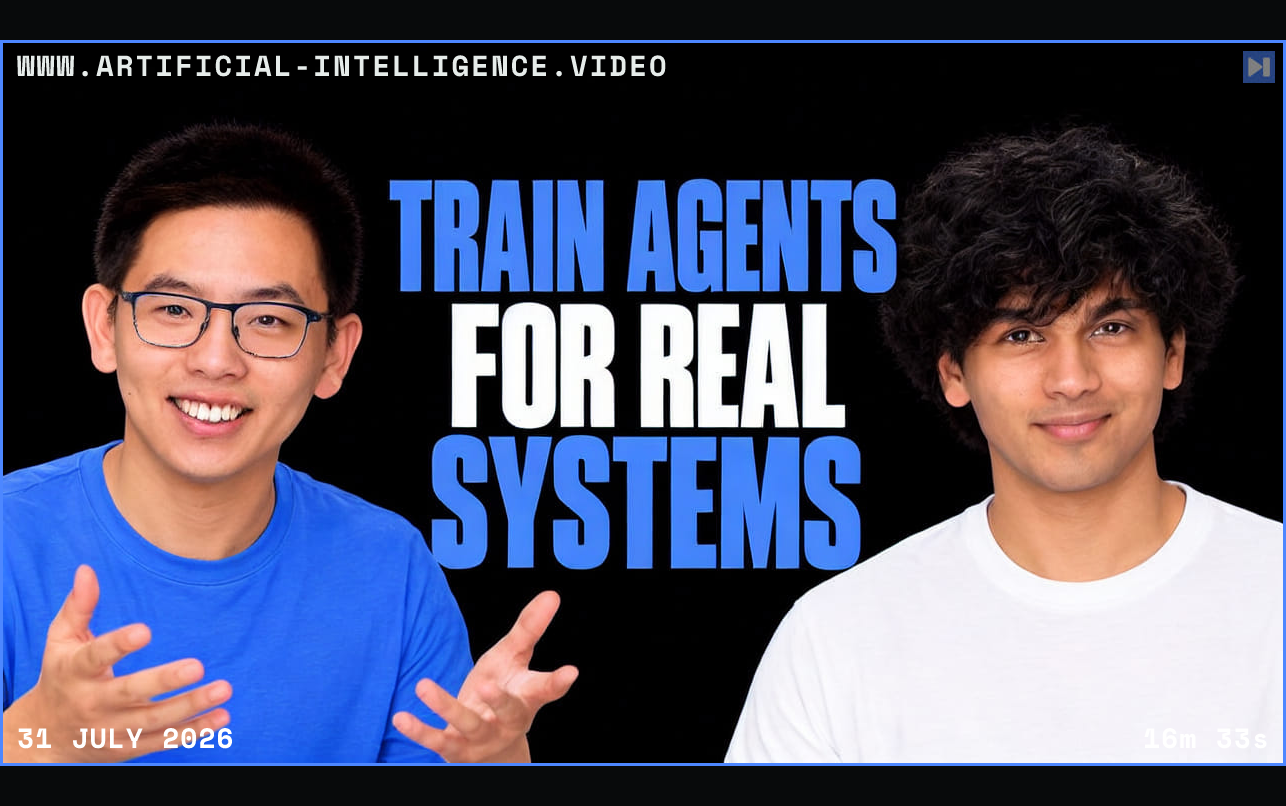
Joseph Wang and Sid Patllollu argue that completing a code change captures only part of a software engineer's work. Their joint talk identifies a training-data gap around understanding customer problemsAI customer discovery investigates users, workflows and constraints to find problems where AI can create measurable value., operating infrastructure and managing the consequences of architecture decisions over long periods.
Joseph Wang and Sid Patllollu describe simulated company environmentsSynthetic data is information generated to represent examples or situations rather than collected directly from the events it describes. containing projects, incidents, customer conversations and operational history. In a distributed-cluster example, an agent must combine that contextContext engineering designs how relevant instructions, evidence, state and tool information are assembled for a model's task. with rolling deployments, failing nodes, monitoring and live traffic, while limiting the impact of its actions.
Joseph Wang and Sid Patllollu explain where a single-node sandboxAn AI agent sandbox is an isolated execution environment that limits which files, processes, networks, credentials, and external systems an agent can access. becomes insufficient for realistic infrastructure work. They outline multi-node environmentsAI compute infrastructure is the hardware, facilities, networks, power, cooling, storage, and software used to train and run AI models. with access to cloud resources, covering provisioning, networking, authentication, authorization, deployment management and other parts of a service's lifecycle.
Joseph Wang and Sid Patllollu discuss challenges such as slow environment setup, resource costs and the remaining gap between simulated conditions and real customer traffic. They present infrastructure as a starting domain with clearer operational requirements, while considering whether lessons from that domain can transfer to broader agent workflows.
 Watch on YouTube