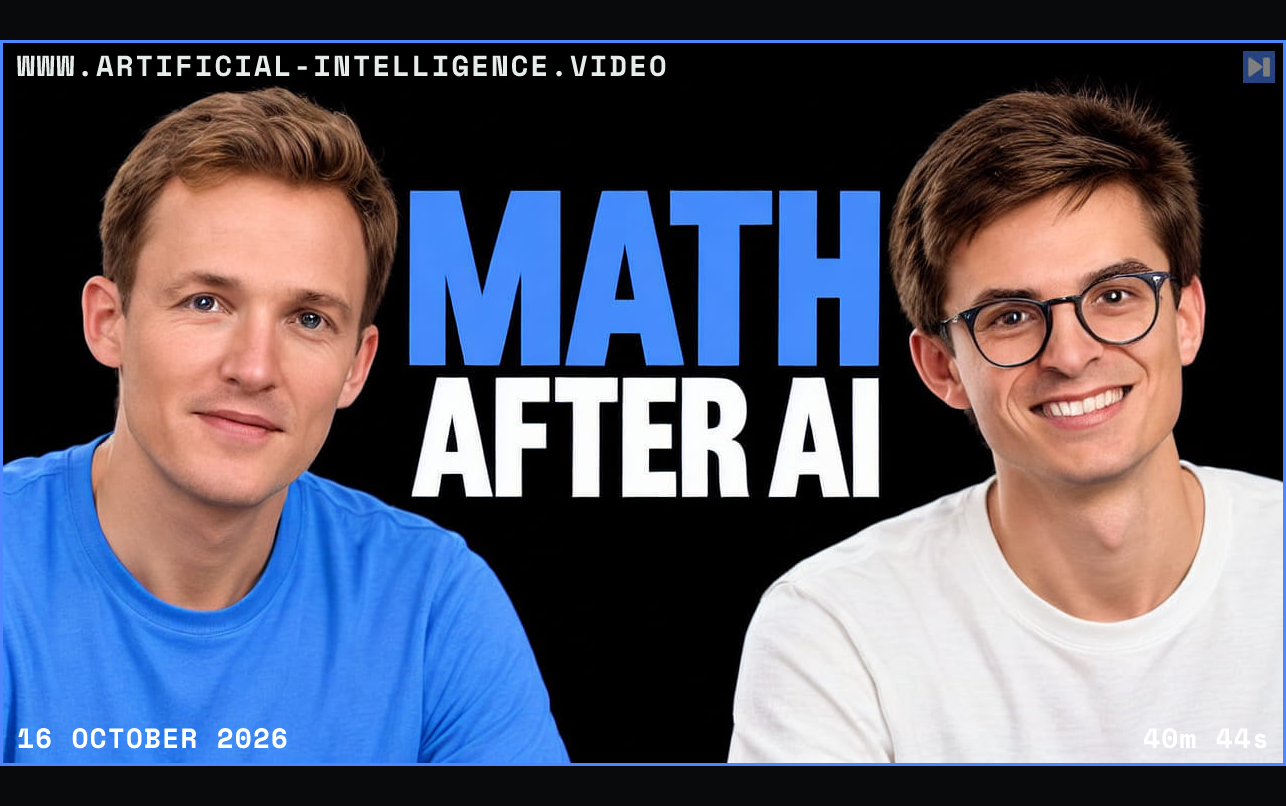
Grant Sanderson separates mathematical work into proving theorems, asking fruitful questions, building theories, finding applications and communicating ideas. He then distinguishes societal applications from the individual benefits of problem-solving practice and aesthetic enjoyment, relating those benefits to teaching and research funding.
Grant Sanderson considers progressively stronger hypothetical machines rather than asserting that every mathematical task is already automated. If models generate proofs, he argues that people can spend more effort understanding the ideas, building coherent theory and checking attribution. Constantin Kogler contributes a short interview excerpt describing excitement about insights obtained through interactions with models.
Grant Sanderson acknowledges that some researchers feel a loss of joy or pioneering purpose, while others feel newly enabled. Even in scenarios where models also generate theories and applications, he sees continuing value in human learning, motivation and communal mathematical activity, without claiming to predict institutional funding or employment precisely.
Grant Sanderson encourages students to clarify what they value in mathematics, discuss it with peers and practice oral explanation. He frames this period as an opportunity to shape research norms and academic credit rather than prescribing a single career path. Channel-support appeals and unrelated promotional links are omitted.
 Watch on YouTube