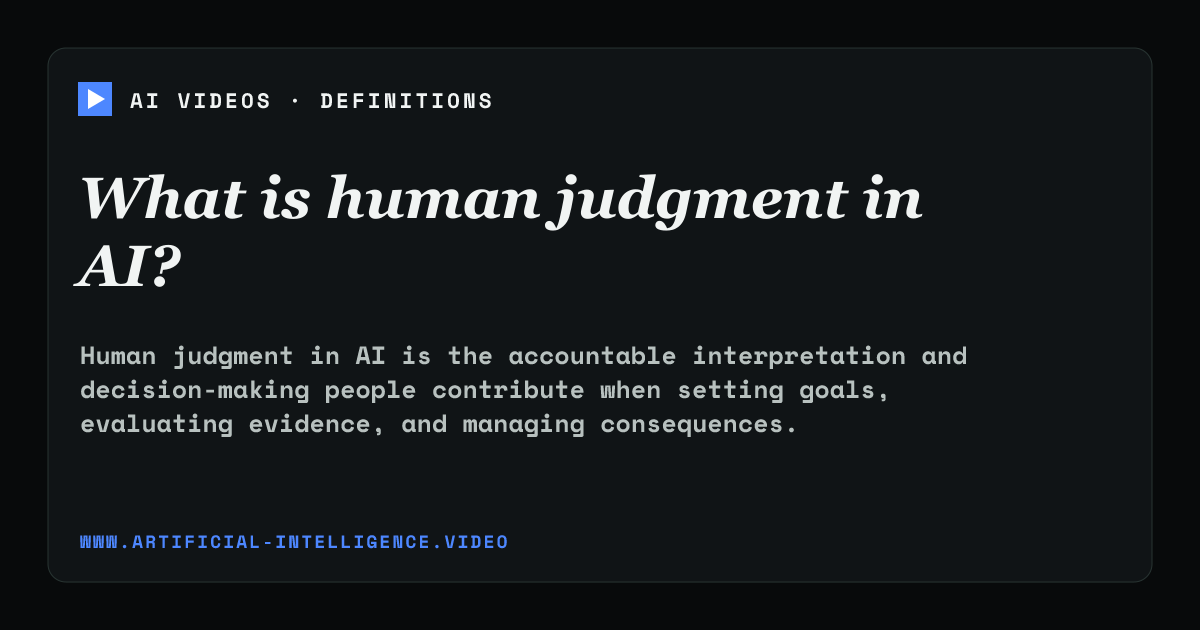
Human judgment in AI includes defining the real problem, selecting evidence, recognizing context, weighing tradeoffs, and deciding whether an automated result is suitable for action. It matters most when objectives are ambiguous, evidence is incomplete, values conflict, or errors could cause meaningful harm.
Models can support judgment by organizing information and offering alternatives, but fluent output is not independent verification. People remain responsible for checking sources, understanding uncertainty, challenging assumptions, and preserving the ability to reject or revise an automated recommendation.
ELI5
Human judgment in AI is the reasoning and accountability people contribute when evidence is incomplete, goals conflict, or a decision has real consequences. AI can organize information, but it does not remove responsibility from the person using it.
For example, an AI system can compare job candidates against stated criteria, but a hiring manager must question biased assumptions, consider context, verify evidence, and own the final decision.
Why is human judgment still needed with capable AI models?
Models can miss context, optimize an imperfect objective, present uncertain claims confidently, and cannot assume human accountability for consequences.
Does human judgment mean manually reviewing every AI output?
No. Review can be risk-based, with stronger human involvement for ambiguous, irreversible, high-impact, or weakly verified decisions.