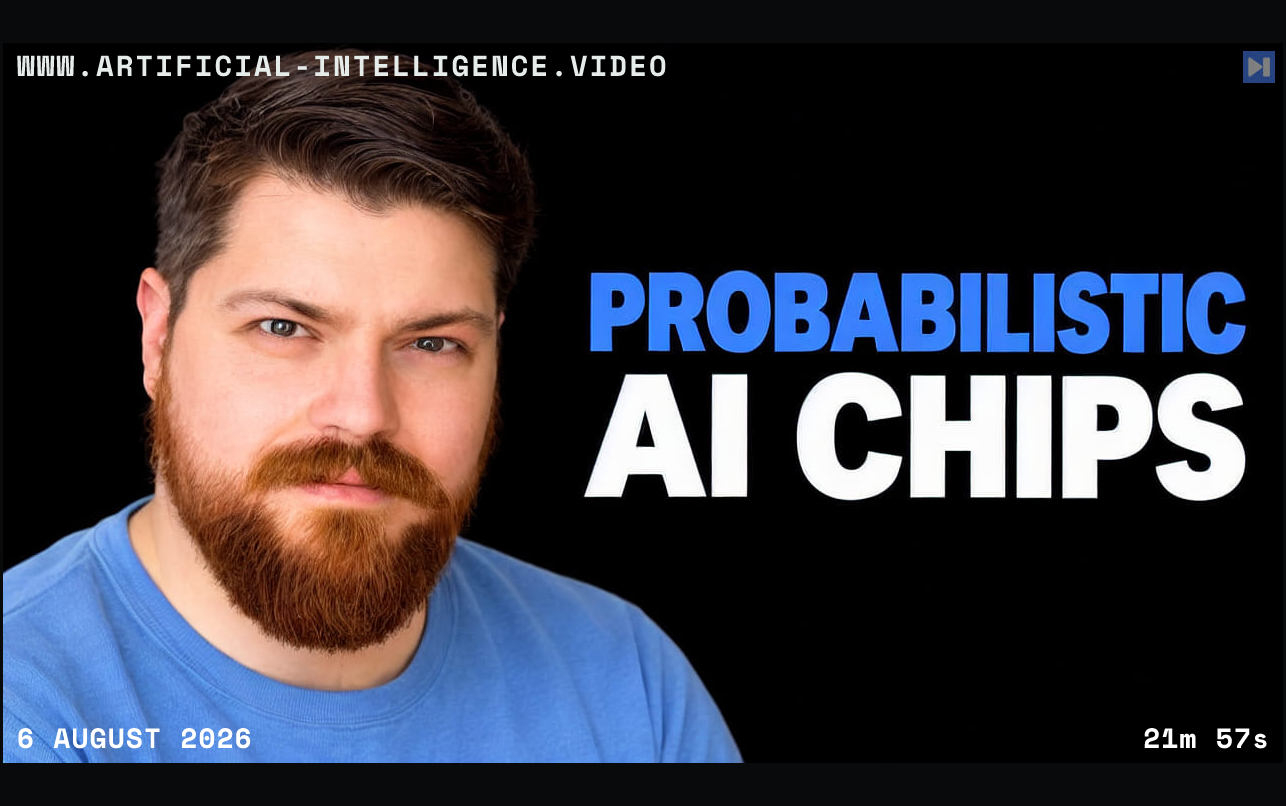
Guillaume Verdon describes probabilistic bitsA probabilistic bit is a two-state computing element whose value fluctuates, allowing randomness to participate directly in computation. that fluctuate between states and says their low-power behavior can implement some stochastic AI algorithms with fewer transistors. His large efficiency and scaling figures are company claims discussed in the interview, not independently verified results presented there.
Guillaume Verdon discusses how diffusion-style and sparse transformerA transformer is a neural network architecture that uses attention to model relationships between elements of its input. operations might map to thermodynamic hardware through a stochastic programming framework and compiler. He distinguishes probabilistic bits from quantum bits and uses the energy cost of resetting deterministic bits to explain the design rationale.
Guillaume Verdon does not propose replacing GPUs wholesale. He describes hybrid systemsAI compute infrastructure is the hardware, facilities, networks, power, cooling, storage, and software used to train and run AI models. that assign some sparse or lower-precision work to thermodynamic chips while retaining deterministic accelerators for dense and high-precision tasks. He acknowledges scientific computing may need precision beyond the strengths of probabilistic devices.
 Watch on YouTube