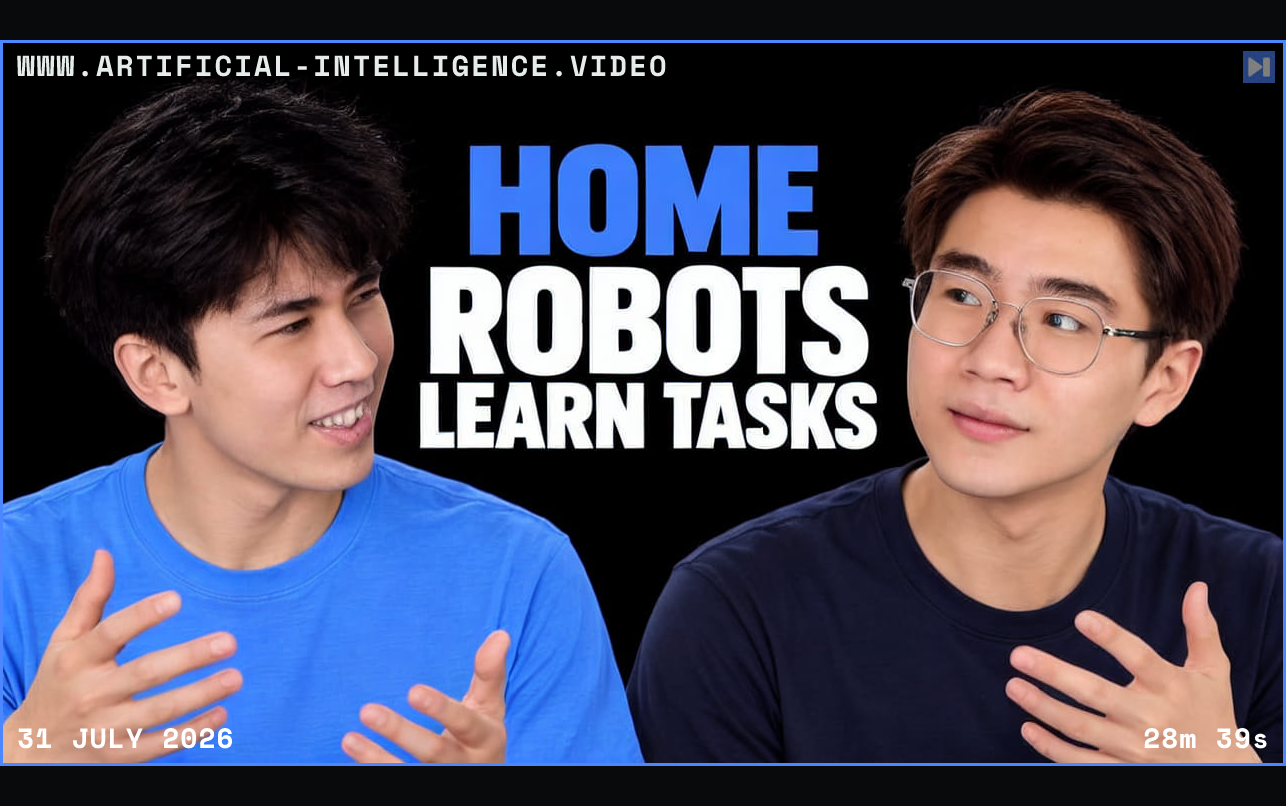
Tony Zhao explains to Brexton Pham how Sunday combines hardware, software, data collection and learned controlA robot policy is the decision-making function that maps observations and goals to actions a robot should take in its environment. for household tasks. He describes performance on unfamiliar homes and garmentsGeneralization is an AI system's ability to apply what it learned to new examples and conditions that were not part of its training experience. as company-reported results for a limited task set, not proof of general household autonomy.
Tony Zhao and Brexton Pham discuss personal preferences, additional training examples and feedbackAn AI feedback loop occurs when AI outputs or their consequences become inputs that influence later model or agent behavior. as ways to adapt a robot's behavior. They also examine the limits of network-dependent control: cloud systems can support higher-level reasoning, but latency and unreliable connectivity motivate local executionOn-device inference runs a trained model on the user's device rather than relying entirely on a remote model service. for time-sensitive actionsRobot control determines how a robot moves and responds to feedback while performing a task..
Tony Zhao presents a live laundry demonstration from the company's workspace, including recovery after a dropped garment. Brexton Pham asks about expanding capabilities and manufacturing, while Tony Zhao describes a staged deployment focused first on specific tasks. Proposed future features are separated from what the demonstration establishes.
 Watch on YouTube