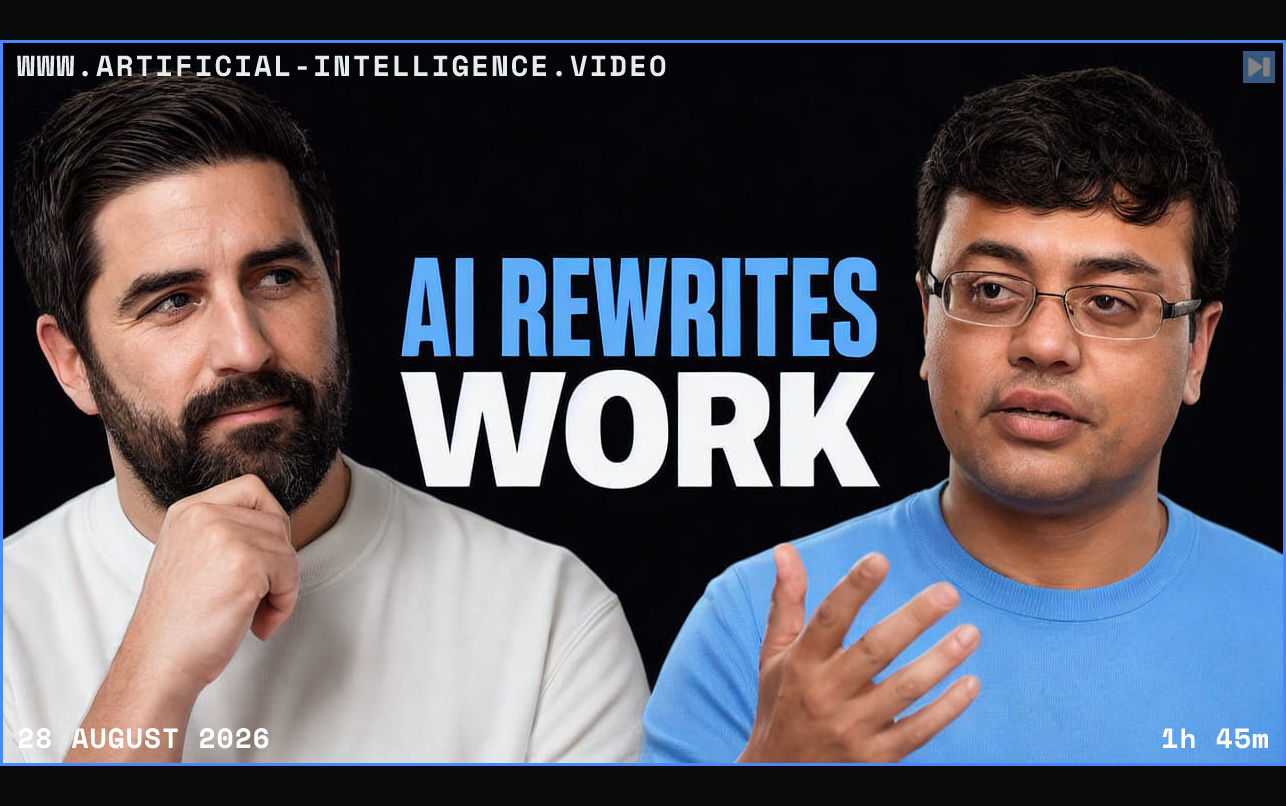
Emad Mostaque argues that remote knowledge workKnowledge-work automation uses AI and software to reduce repetitive effort in research, analysis, communication, documents, and administrative tasks. will face the first major disruption because AI systems can reproduce tasks, institutional knowledge and communication at far lower cost. He predicts that robotics will later extend that pressure to driving, logistics and other physical work, though the interview presents his two-year timeline as a forecast rather than an established fact.
Peter McCormack and Mostaque examine how rapid progress in humanoid robotsA humanoid robot is a robot whose body and movement are designed around a broadly human-like form. could remove the need to redesign environments around machines. They discuss self-learning robot policiesA robot policy is the decision-making function that maps observations and goals to actions a robot should take in its environment., manufacturing scale and serious safety risks from powerful systems that can be deployed without mature regulation or secure software.
The conversation then turns to government and public institutions. Mostaque proposes AI systems that check policy, expose corruption and represent citizens through personal agents, while both speakers acknowledge that model biasAI model bias is a systematic tendency in a model's outputs that reflects imbalanced data, design choices, objectives or deployment context., ownership and persuasion create new concentrations of power rather than automatically producing neutral decisions.
Mostaque also argues that frontier labs may reserve their most capable systems for internal research and commercial discovery while offering narrower models to the public. He connects that split to AI-assisted scienceAI-assisted scientific discovery uses AI to support hypothesis generation, experiment design, analysis, simulation, literature work, and interpretation while researchers retain responsibility., faster inference and the need for new economic arrangements if payroll taxes and wages decline. Sponsor messages, book promotion and unsupported claims about exact scientific timelines are omitted from the editorial conclusions.
 Watch on YouTube