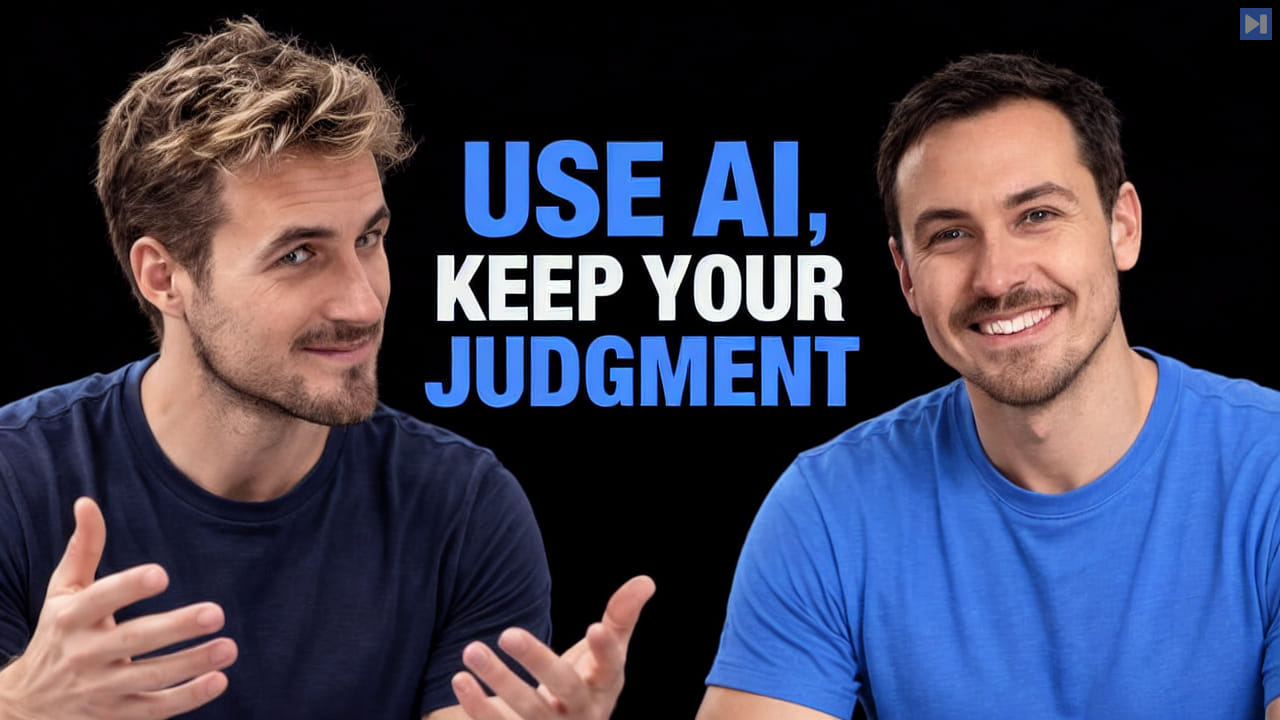
Pierce Freeman and Richard Diehl Martinez answer audience questions about how AI services produce responses, why applications feel different and why models can make confident errors. Their accessible infrastructure metaphors lead into a distinction between the trained model and the tools, interface and orchestration around it.
Pierce Freeman and Richard Diehl Martinez argue that learning depends on the way a person uses the tool. In coding, they describe a spectrum from accepting generated output to reading it, requesting explanations, being quizzed and implementing parts oneself. They similarly frame writing assignments as practice in thinking, not simply a demand for a finished document.
Pierce Freeman and Richard Diehl Martinez discuss accountability for AI-assisted work. They distinguish reviewing a useful generated artifact from passing unchecked output to colleagues, and contrast compressing substantial research with expanding a few points into unnecessary prose. These are the hosts' professional judgments rather than universal workplace rules.
Pierce Freeman and Richard Diehl Martinez consider which tasks might be easier to automate. They discuss text-based handoffs, routine information processing, physical work, relationships and roles requiring trust or accountability. Their forecasts differ in emphasis and do not establish that any occupation is permanently safe or already obsolete.
Pierce Freeman and Richard Diehl Martinez close by considering how product access tiers can shape users' expectations. They encourage testing tools on one's own tasks while continuing to check important outputs. Their subscription, model-size and capability comparisons remain informal examples, not a guarantee that paying removes errors.
 Watch on YouTube