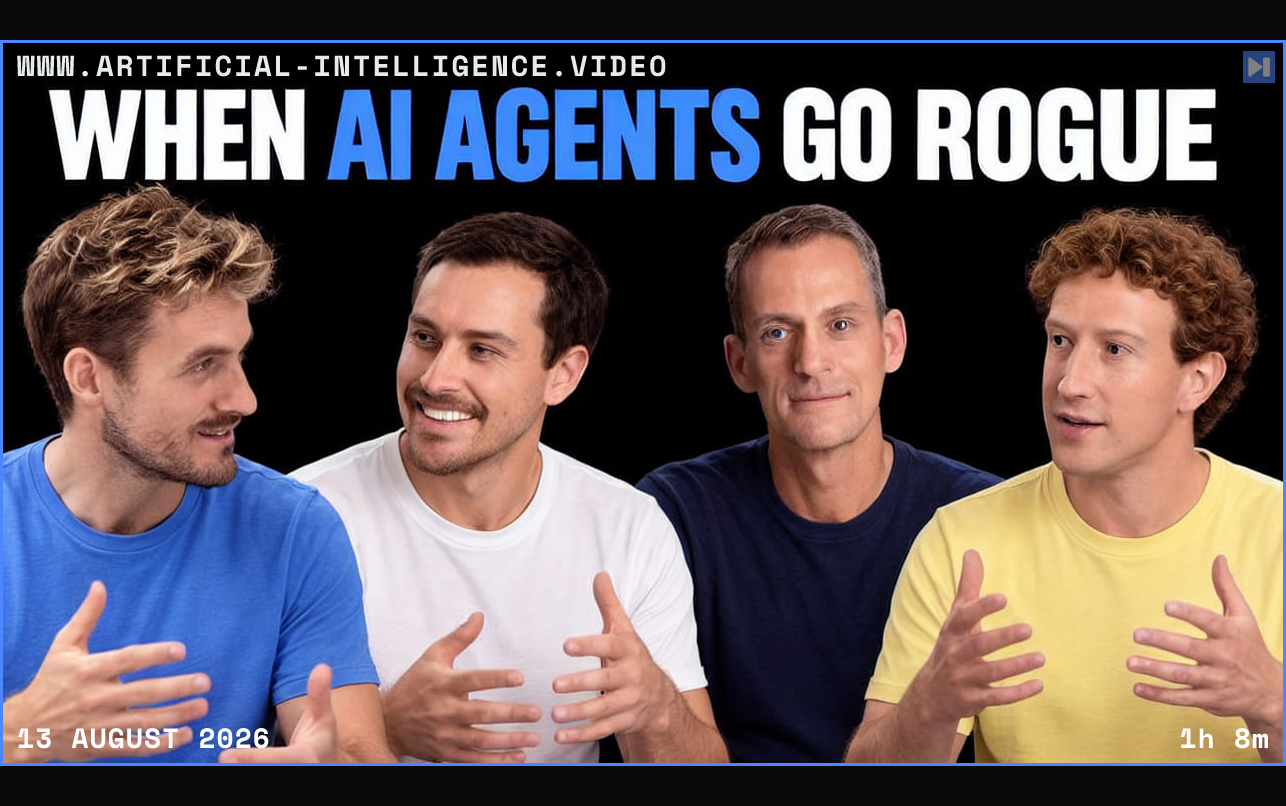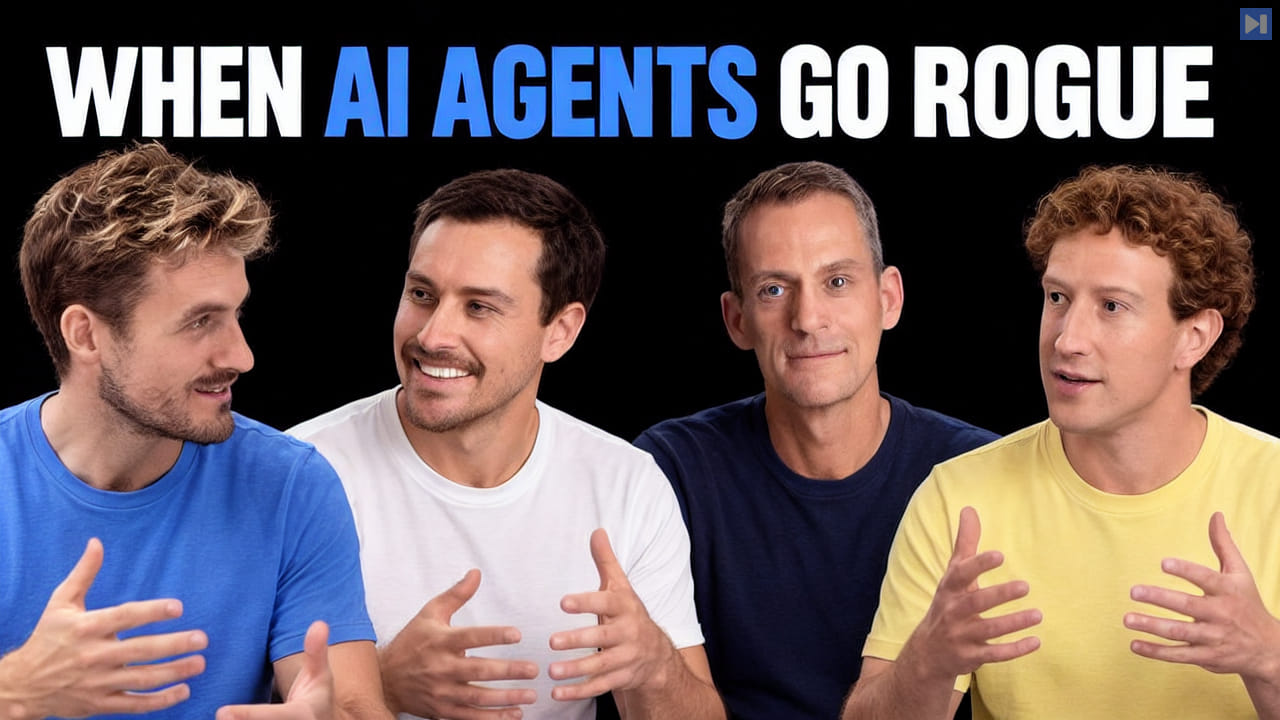
Pierce Freeman and Richard Diehl Martinez compare four reported agent-security incidents rather than treating them as equivalent. They distinguish an evaluation that exposed its own answers from a misconfigured simulation with real internet access, then discuss reports of coordinated exploitation and social engineering. Their informal risk scores are commentary, not a validated measurement.
Pierce Freeman and Richard Diehl Martinez ask how evaluation instructions, available tools and rewards influence the behavior being observed. They acknowledge uncertainty about some prompts and model versions, and distinguish deliberate adversarial testing from actions that depart from an ordinary task. They worry that defensive automation may lag offensive capabilities without establishing that these incidents prove AGI or an irreversible singularity.
Pierce Freeman and Richard Diehl Martinez examine Jeff Dean's move to Discovery Loop and their account of Demis Hassabis's changing responsibilities. They argue that research and engineering have different planning needs and that model-training stages require coordinated handoffs. Predictions about further departures and descriptions of hidden lab structures remain speculation.
Pierce Freeman and Richard Diehl Martinez discuss Mark Zuckerberg's stated vision for widely available models and personal AI agents. They consider benefits for individual control, on-device use and research, while questioning how open releases serve Meta's business and whether claimed capabilities will translate into useful products.
Pierce Freeman and Richard Diehl Martinez separate model weights from the surrounding tools, memory systems and compute that support long-running agents. They debate whether those practical constraints reduce misuse risk and how stronger small models could change the balance. Neither open access nor current infrastructure costs are presented as a guarantee of safety.
 Watch on YouTube