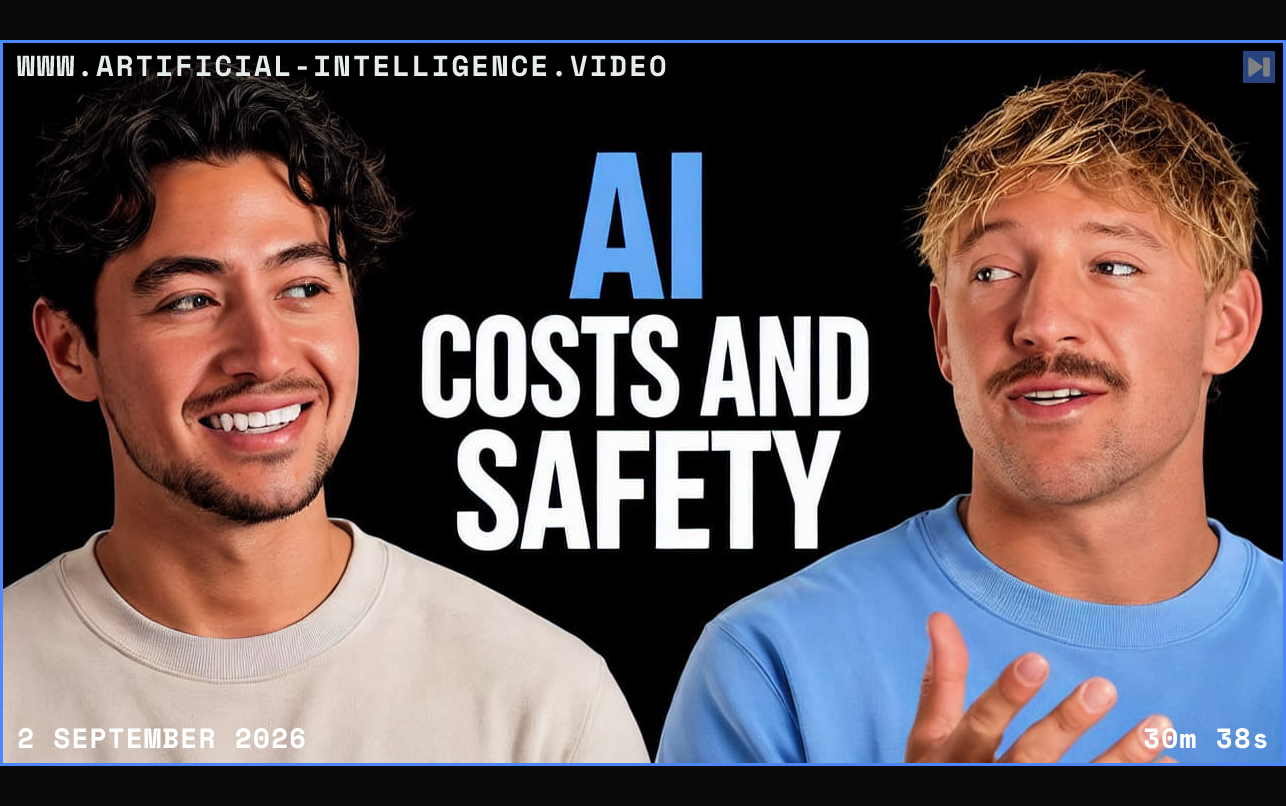
Nick Saraev and Jack Roberts assess Fable 5.1 through reported task-completion benchmarks and operating costs. They argue that token prices alone cannot establish valueEvaluation is the systematic assessment of a system's behaviour or results against explicit criteria. because models use different amounts of computation to complete the same workCost per completed task measures the total AI, tool, infrastructure, retry, and repair expense for each verified useful outcome., and they discuss lower caching costs and longer autonomous tasks.
Nick Saraev and Jack Roberts then examine OpenAI’s description of Astra’s cybersecurity capabilities and safeguards. They distinguish the announced safety rationale from their own speculation about competitive release timing, and debate whether readable reasoningChain-of-thought monitoring analyzes a reasoning model's exposed intermediate reasoning for signs of errors, policy violations, deception, or unsafe plans. is necessary or merely helpful for oversight. Their architectural claims are commentary in the discussion rather than independently demonstrated findings.
Nick Saraev and Jack Roberts weigh restrictions on generative AI for younger pupils against the opportunity to develop AI literacy. They worry that outsourcing basic reasoningHuman judgment in AI is the accountable interpretation and decision-making people contribute when setting goals, evaluating evidence, and managing consequences. can reduce practice, while acknowledging that guided use could teach useful skills. Their discussion presents opinions and anecdotes, not a controlled assessment of educational outcomes.
Nick Saraev and Jack Roberts close with audience questions about reviewing conversation history to improve instructions, bias in public AI predictions and maintaining customer continuity when model-provider relationships change. They recommend checking recurring failure patternsAn AI feedback loop occurs when AI outputs or their consequences become inputs that influence later model or agent behavior. and recognizing how strong public positions can shape later judgments.
 Watch on YouTube