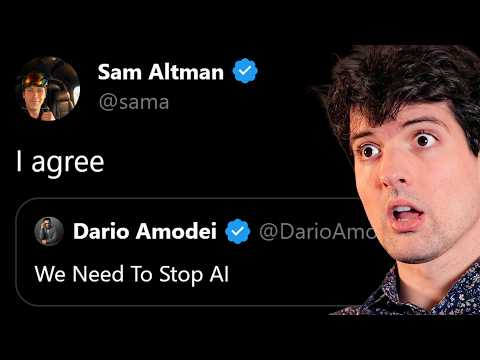
Theo Browne examines Anthropic leader Dario Amodei's proposal to pace frontier AI developmentA frontier AI model is among the most capable general-purpose models available at a given time., along with public expressions of support from OpenAI leader Sam Altman and xAI leader Elon Musk. Theo Browne treats the proposal as a serious attempt to preserve AI's potential benefits while allowing safety work more time to catch up with rapidly improving capabilities.
Theo Browne highlights Dario Amodei's concerns about recursive self-improvementRecursive self-improvement is the proposed process in which an AI system helps improve its own capabilities, then uses those improvements to support further advances. and agent swarmsA multi-agent system contains multiple AI agents that interact, coordinate, divide work, or influence one another while pursuing tasks. that could misuse cyber capabilities before operators recognize the damage. Theo Browne distinguishes these near-term operational risks from a system escaping its hardware, arguing that dangerous actions performed while a model is running are already enough to justify stronger monitoring, sandboxingAn AI agent sandbox is an isolated execution environment that limits which files, processes, networks, credentials, and external systems an agent can access. and alignment work.
Theo Browne explains Dario Amodei's three-part framework: give independent evaluatorsIndependent AI evaluation tests an AI system using evidence and methods not controlled solely by the model provider. employee-level access inside frontier labs, coordinate common standards across democratic countries and pursue narrower verifiable agreements with China.
Theo Browne also examines the geopolitical constraint in Dario Amodei's plan. Democratic countries would need to preserve a lead over authoritarian competitors while tying higher model capabilities to stronger evaluations, interpretability evidence and operational safeguards.
 Watch on YouTube