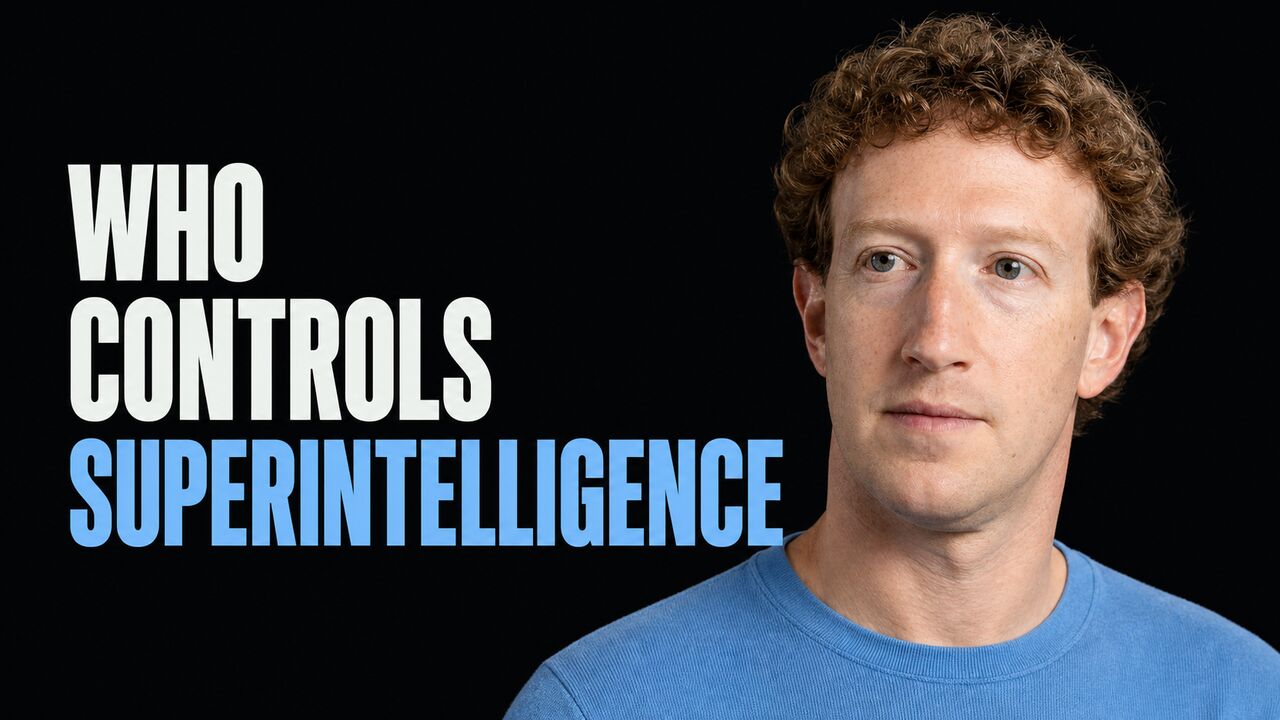
Mark Zuckerberg's vision centers on personal superintelligenceSuperintelligence is a hypothetical level of AI capability that would greatly exceed human ability across most important intellectual tasks. that helps individuals pursue their own goals through devices such as AI glasses, with broad access supported by open models and free services. The plan is framed as a counterweight to centralized systems whose values and decisions are controlled by a small number of institutions.
The economic structure complicates that promise. Even if model access is widespread, the most capable training and inference still depend on scarce computing resourcesAI compute infrastructure is the hardware, facilities, networks, power, cooling, storage, and software used to train and run AI models. that can be auctioned to those able to pay. That leaves a gap between distributing software and distributing the power to improve, operate and direct it at the largest scale.
The video is also skeptical of an optimistic transition from automation to more creative work. Personalized alignment may give people more control over an assistant's behaviour, but recursive self-improvementRecursive self-improvement is the proposed process in which an AI system helps improve its own capabilities, then uses those improvements to support further advances. could create runaway advantages for whoever first controls the strongest systems. The central question is therefore not only whether superintelligence becomes personal, but who retains practical control over its compute, development and economic consequences.
 Watch on YouTube