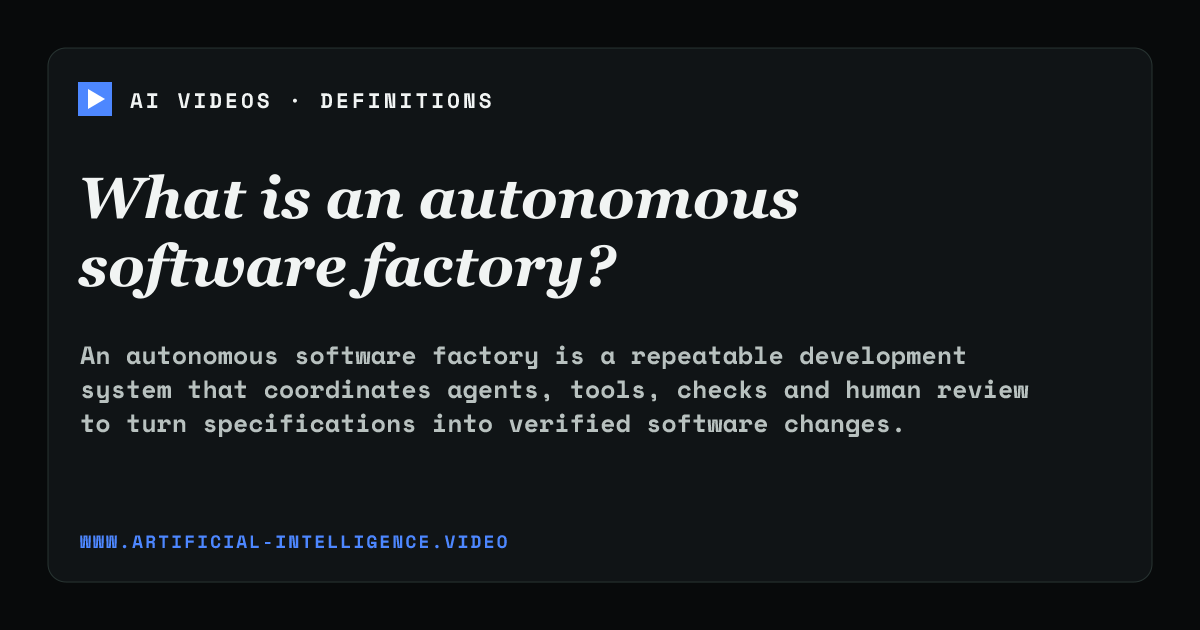
An autonomous software factory organizes AI-assisted development as a controlled production process rather than a collection of isolated prompts. It defines how work is scoped, implemented, tested, reviewed and prepared for human approval.
The factory can encode its process in project instructions, reusable skills, isolated workspaces and quality gates. Automation does not remove accountability: people still define requirements, permissions, acceptance evidence and the final merge decision.
ELI5
An autonomous software factory is a connected development system where AI agents help move work through planning, coding, testing and review under shared controls. It combines more than one coding assistant into a repeatable engineering workflow.
For example, one agent may implement a scoped change, another may review it and automated tests may decide whether it can move forward. People still set the goal, resolve unclear decisions, own platform rules and approve risks that should not be delegated.
Is an autonomous software factory one model?
No. It is the larger workflow that coordinates models, agents, tools, instructions, evidence and approval boundaries.
Why keep a human at the final merge?
Human review preserves accountability for requirements, trade-offs and risks that automated checks may not fully capture.