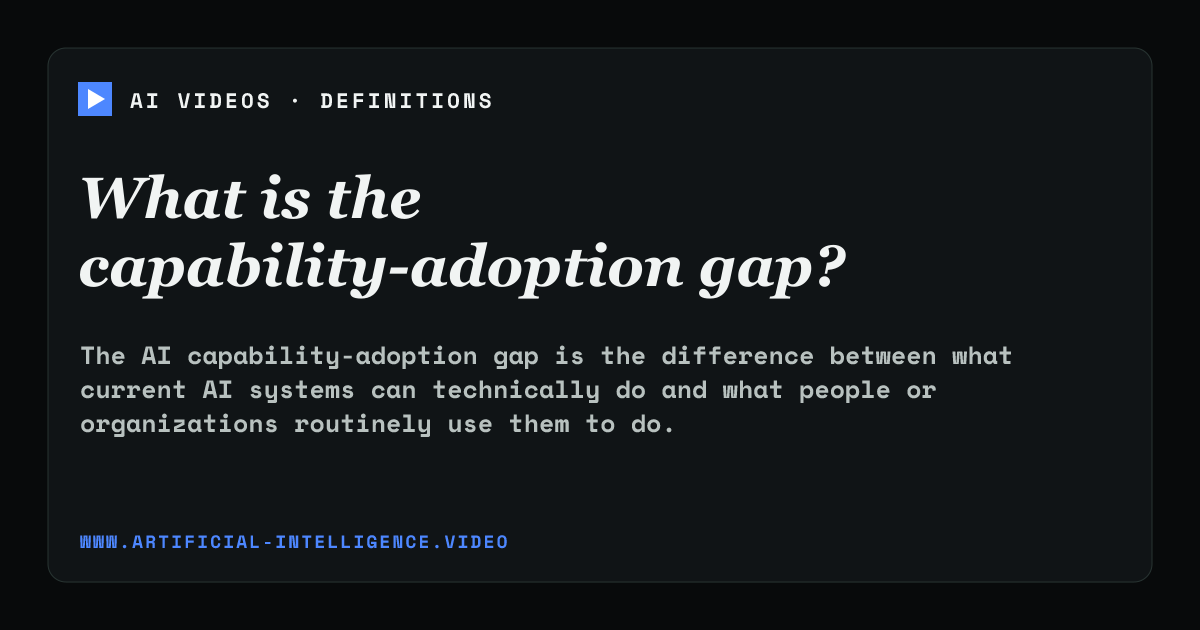
The AI capability-adoption gap grows when model performance advances faster than products, workflows, trust, governance, skills, and institutions can adapt. Demonstrations may show impressive capability while everyday use remains limited or concentrated in a few tasks.
Closing the gap requires more than stronger models. Products must make capabilities accessible and reliable, organizations must redesign work responsibly, and users need evidence that changing behavior produces enough value to justify the friction and risk.
ELI5
The capability-adoption gap is the distance between what current AI systems can technically do and what people regularly use them to do. New capabilities can appear faster than products, workplaces, skills, and rules can adapt.
For example, a model may be able to summarize complex reports, but a company might not use it because staff cannot connect it to approved documents or verify its sources. Better integration and trustworthy review can help close that gap.
What causes the AI capability-adoption gap?
Rapid model progress can outpace product design, workflow integration, trust, governance, training, infrastructure, and institutional change.
Does a capability-adoption gap mean AI is overhyped?
Not necessarily. Real capability can exist before products and organizations make it reliable, accessible, economical, and routine.