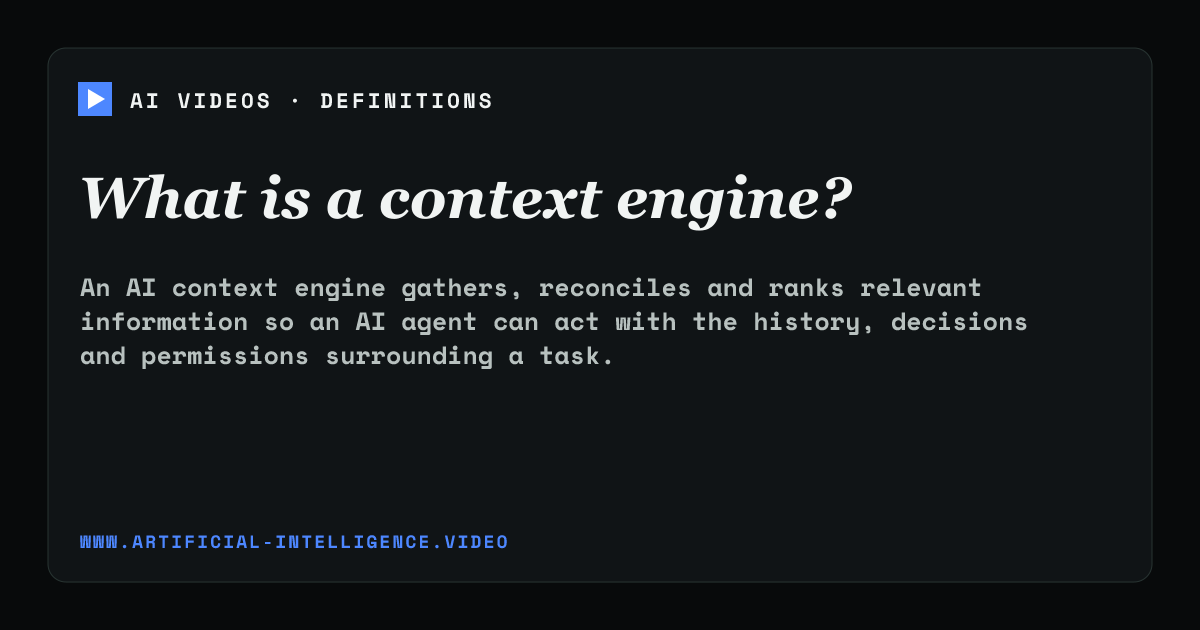
An AI context engine connects sources such as code repositories, tickets, documents and conversations, then selects the evidence most relevant to the agent's current task. It provides a synthesized view rather than forcing the agent to inspect every available record independently.
A production context engine must handle contradictory and stale information, preserve source identity, respect access controls and explain which evidence shaped its result. This reduces confident mistakes caused by missing organizational history, but it does not remove the need for validation, human oversight or bounded agent permissions.
ELI5
A context engine gathers and ranks relevant information for an AI agent from sources such as code, tickets, documents, and conversations. It tries to give the agent the history, decisions, and permissions needed for the current task without loading everything.
For example, before fixing a customer issue, the engine may find the account record, recent support messages, product documentation, and an earlier decision. It must preserve source identity, respect access controls, and show conflicts or stale information instead of blending them silently.
How does an AI context engine work?
It retrieves information from approved sources, resolves or exposes conflicts, ranks evidence for the current task and returns a bounded context that the agent can use.
How is a context engine different from giving an agent more tools?
Tools provide access to data or actions. A context engine also selects, reconciles and structures relevant evidence so the agent is less likely to make ad hoc choices among conflicting records.