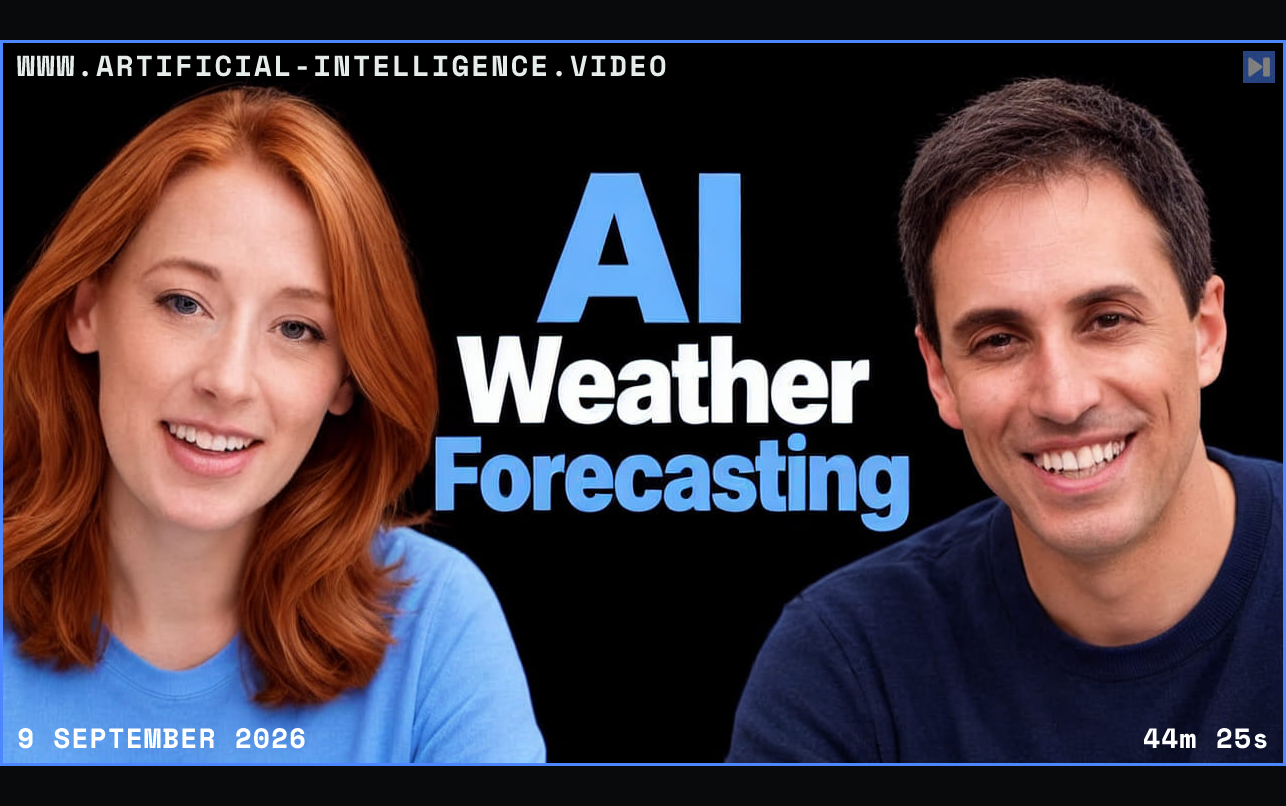
Hannah Fry examines AI weather forecasting through a hurricane case study and the progression from numerical simulation to learned global models. The guest describes how forecasts of Hurricane Melissa helped inform official forecasters, while acknowledging that the effect of extra warning cannot be measured against a known alternative outcome.
The discussion contrasts numerical methods that approximate fluid equations with machine learningMachine learning is a branch of AI in which systems learn patterns from data to make predictions or generate outputs, rather than relying only on rules explicitly written for each task. that learns patterns from historical weather dataTraining data is the collection of examples and signals used to adjust an AI model's parameters so it learns useful patterns.. GraphCast connects local and global representations, while GenCast produces multiple plausible futures rather than a single average forecast. Diffusion modelsA diffusion model generates or transforms data by learning to reverse a gradual noising process, often through a sequence of denoising steps. and functional generative networks provide different ways to generate that range of scenarios and communicate uncertainty.
The guest describes WeatherNext 3 as combining raw satellite imagery with estimates of current weather and predicting observations at weather stations. Higher spatial and temporal resolution, hourly forecast updates, and additional wind and solar variables are intended to support electricity supply and demand forecasting, alongside broader agricultural applications.
Performance claims are qualified by variable, region, forecast horizon and storm intensity. The guest warns against treating one model as uniformly best, explains that AI errors can drift toward average weather, and identifies limited examples of rare events as a continuing research challenge. The closing discussion prioritizes evaluationEvaluation measures how well an AI system performs against defined tasks, criteria and failure conditions using repeatable evidence. and treats direct impact forecasting and exchanges with language and video models as future directions.
 Watch on YouTube