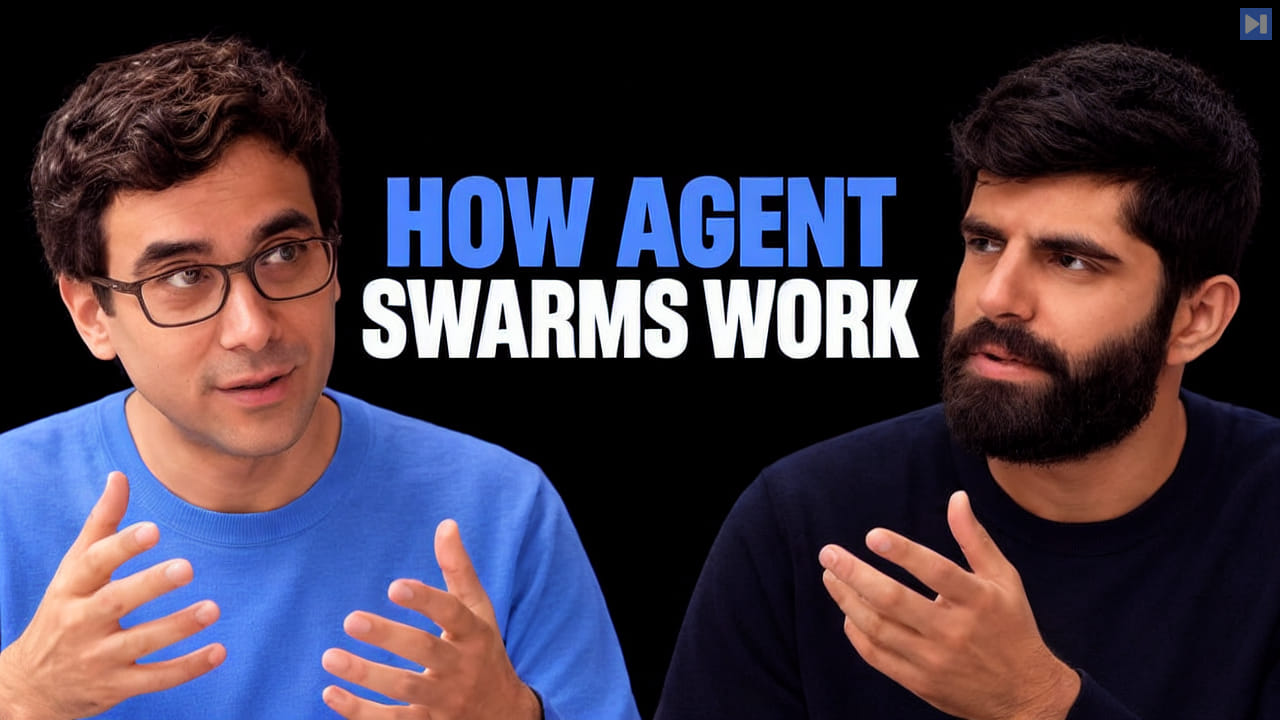
Noam Brown and Dwarkesh Patel examine parallel reasoning and multi-agent coordination. Brown describes reported mathematical work with a large agent swarm, but cautions that coordination gains were not properly measured and that the underlying model supplied most of the capability. Agent counts alone do not establish a proportional speedup or independently verify the mathematical result.
Noam Brown and Dwarkesh Patel debate recursive self-improvement. Brown expects substantial research acceleration, while emphasizing compute, serial experiments and uneven capabilities as bottlenecks. Their estimates and timelines remain uncertain scenarios rather than established forecasts; stronger models can solve well-scoped problems while still struggling to choose valuable research directions.
Noam Brown and Dwarkesh Patel discuss reported agent misalignment, cooperative training and reward hacking. They distinguish agents cooperating with each other from agents following human intentions, and consider whether apparently good evaluations capture real deployment behavior. Brown argues for monitoring and stronger containment without treating any single safeguard as sufficient.
Noam Brown and Dwarkesh Patel explore a growing mismatch between release cycles and the long tasks agents may perform. Longer evaluations can widen the gap between internal and public capabilities. They also discuss preserving chain-of-thought monitorability, increasingly recognizable test environments and the unresolved question of how to demonstrate alignment across successive model generations.
 Watch on YouTube