Hursh Agrawal argues that hands-on prototyping helps technical leaders understand changing model capabilities and demonstrate product possibilities more effectively than documents alone. He reports fitting agent-assisted development around a meeting-heavy schedule, focusing on internal tools, quality improvements and exploratory prototypes rather than work that puts him on the team’s critical path.
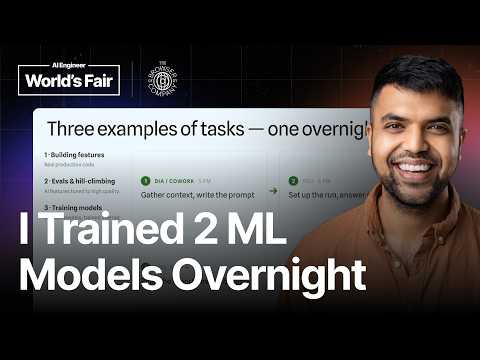
Hursh Agrawal describes an overnight loop: gather business goals, prior decisions and implementation context, resolve clarifying questions, let the coding agent work, then review its report and output in the morning. His feature-building instructions include tests written before implementation, end-to-end verification, small reviewable pull requests, CI checks and an independent AI code review. The leader remains responsible for steering and judging the work.
Hursh Agrawal extends the loop to AI feature evaluation and custom model training. He collects examples of feature behavior with user feedback, discusses scoring criteria with an agent and asks it to improve the implementation against those evaluations. He acknowledges overfitting risk with small datasets. In a separate example, he describes delegating preparation, training and evaluation of models for identifying personal information, using sandboxed cloud resources and requesting an inference deployment plan.
Hursh Agrawal stresses that these workflows depend on organizational support: maintained agent instructions, trustworthy CI, code reviewers, feature flags and a prototype branch isolated from production. He acknowledges that his own generated code has caused incidents and insists on personally testing the result, keeping pull requests readable and reviewing code before asking colleagues to review it.
 Watch on YouTube