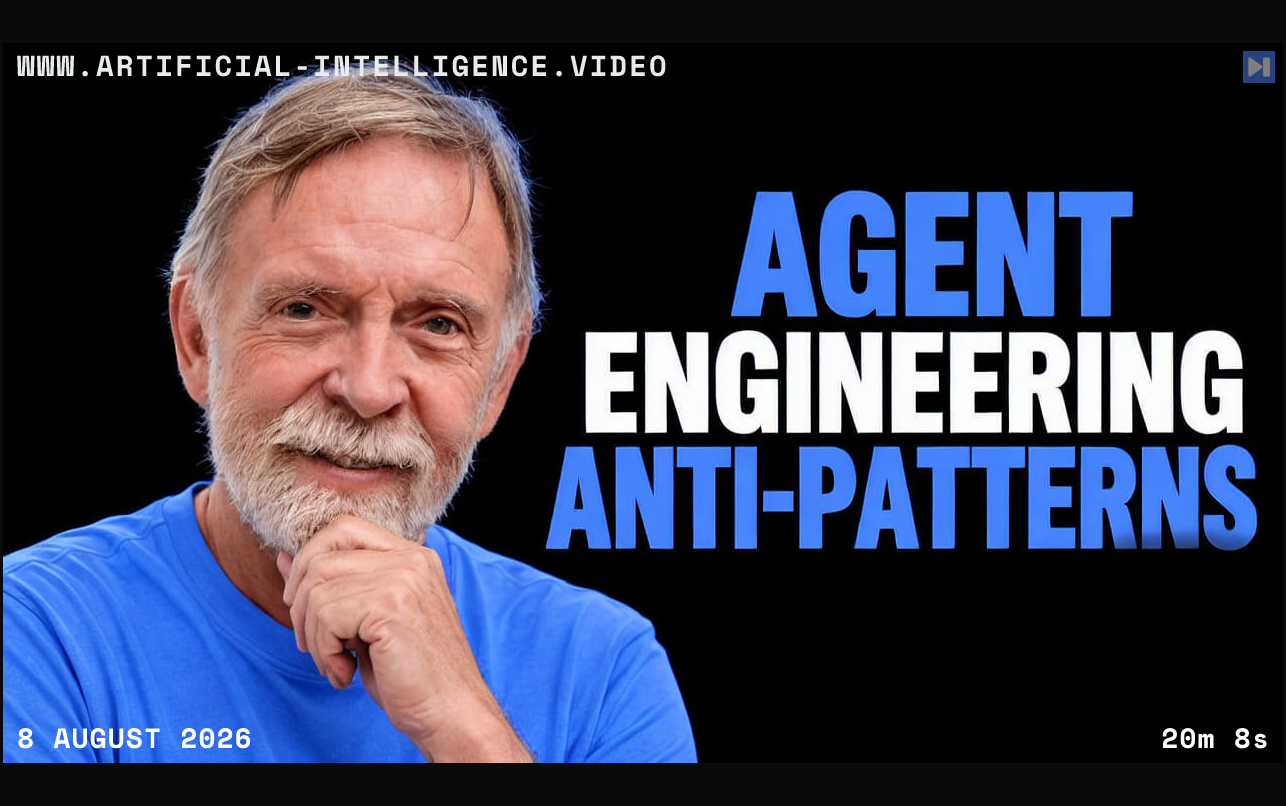
Frank Coyle presents the Claude Certified Architect exam as a map of production skills for agentic AI rather than merely a credential. Its scenario-based domains cover agent architecture, Claude Code configuration, prompt and output structure, tool and Model Context Protocol design, context management and reliability, with anti-patterns used to show why plausible implementations fail.
Frank Coyle explains that a language model proposes tool callsAI tool calling lets a model request a structured operation from software instead of only returning natural-language text. but external code executes them, so an agent loop must inspect the stop reason, run the requested tool, return the result and check for incomplete output or token limitsAgent completion verification checks evidence that an agent achieved the requested outcome rather than merely producing intermediate work.. Human escalation remains appropriate when confidence is low. Hierarchical project instructions can constrain coding behavior at global, project and directory levels.
Frank Coyle recommends small, specialized agentsAgent orchestration coordinates AI agents, tools, people, tasks, state, and control flow so a larger workflow reaches a verified outcome. with limited tools and isolated context rather than one overloaded agent or unrestricted transcript sharing. Context forks, summaries and compactionContext engineering designs how relevant instructions, evidence, state and tool information are assembled for a model's task. keep long tasks manageable and reduce groupthink, while continuous-integration workflows should avoid interactive pauses and may use batch processing when latency is acceptable. His broader advice is to learn by building, observing failures and turning them into explicit anti-patterns.
 Watch on YouTube