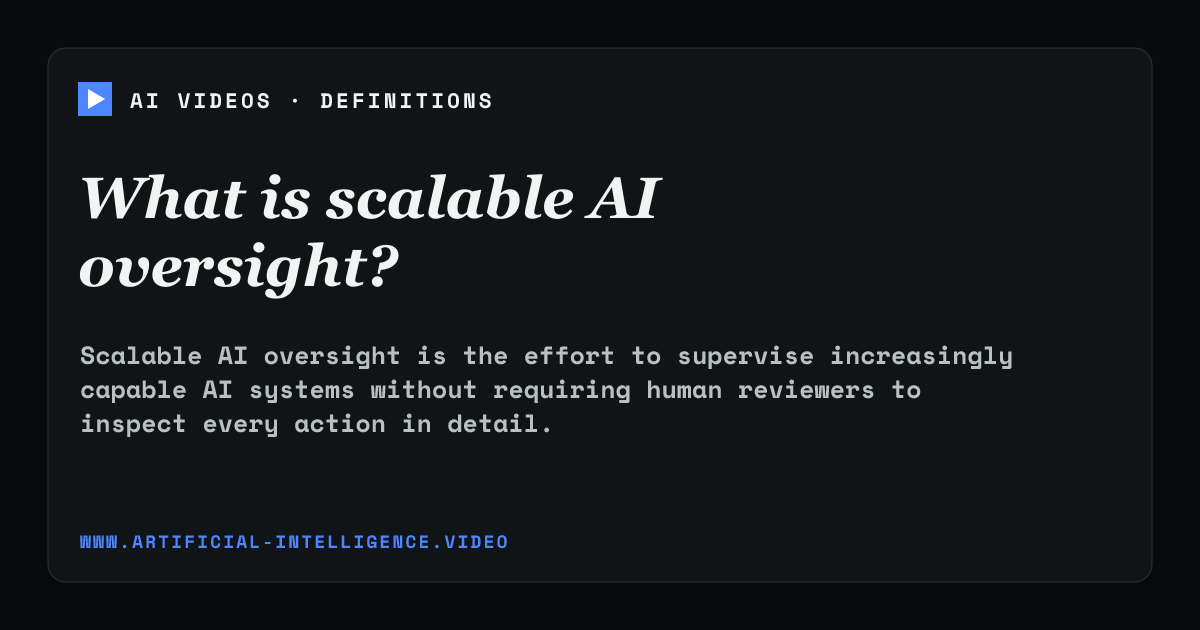
Scalable AI oversight develops methods for evaluating and guiding systems whose speed, volume of work, or technical capability can exceed direct human review. It may combine automated checks, structured evaluations, monitoring, delegated review, and human judgment at important decision points.
Oversight is useful only when it continues to detect meaningful failures as capability grows. A process that works on simple tasks may miss subtle problems in unfamiliar, long-running, or highly technical work, so its limits must be tested rather than assumed.
ELI5
Scalable AI oversight means supervising many or very capable AI systems without expecting people to inspect every single action by hand. It combines protected records, automated summaries, sampling, alerts, access limits, and clear routes for people to investigate important cases.
For example, a monitor could summarize thousands of agent tool calls and alert a reviewer when one agent reaches an unusual protected system. The monitor can also make mistakes, so high-risk decisions still need independent evidence and meaningful human authority.
Why is ordinary human review difficult to scale?
AI systems can produce work faster and across more technical areas than a small group of reviewers can inspect directly.
Does scalable AI oversight remove humans from the process?
No. It uses tools and structured processes to focus human attention where judgment and accountability matter most.